Search for the best free personality tests online and you get two kinds of results: quizzes that flatter you, and academic instruments that hand you five numbers and no explanation. This comparison is an attempt to sort the ten most-used options by what they actually do — the model each one is built on, what the free result contains before any paywall, how long it takes, and which question it is genuinely good at answering.
One disclosure before anything else, because it changes how you should read the rest: MoodyWonder is our own platform, and it appears at number three on this list. We have tried to earn that by reviewing ourselves the way we review everyone else, including the things we do not offer — there is no DISC assessment on MoodyWonder, and 16Personalities has a decade of refinement we do not. Where we say something good about our own product, check it against the free version yourself; it costs nothing, which is rather the point of the list.
The best personality test depends on what you want to know. Use the Big Five for an accurate description of your traits, an MBTI-style test for a memorable map of how you think, the Enneagram for the motivation underneath your behaviour, DISC for workplace communication, and a RIASEC interest inventory for career direction. No single model covers all five.
A note on what these tests are. A personality assessment is a structured way of asking you about yourself, and its output is a description, not a diagnosis. None of the tests below screen for mental health conditions, and none of them should be used to decide whether to hire someone or to explain away something you would rather not change. What they are good for is language — giving a name to a pattern you have noticed but never had a word for, which is what makes the pattern discussable in the first place.
What makes a personality test worth taking
Five criteria decide the ranking below, and they pull against each other often enough that no test wins on all five.
Scientific foundation
The models differ enormously in how much research stands behind them, and this is the single most misunderstood point in the category. The Big Five was not invented by anyone — it fell out of decades of statistical analysis of the words people use to describe each other, and the same five factors keep reappearing across languages, cultures and age groups. It is what personality psychologists actually use.
The type-based systems have a different history. The MBTI framework descends from Carl Jung's theory of psychological types, which was a work of clinical intuition rather than measurement, and academic reviews have been consistently critical of its test-retest stability and its assumption that people fall into discrete categories. DISC comes out of 1920s work by William Marston and has been developed largely inside corporate training rather than research. The Enneagram's origins are older still and essentially spiritual, and its empirical support is the thinnest of the four.
This does not make the type systems useless. It makes them a different kind of tool — a shared vocabulary rather than a measurement — and a test that pretends otherwise is the one to distrust. Our own knowledge base entry on type frameworks goes through where the four-letter model holds up and where it does not.
Accuracy and reliability
Reliability is the boring question that matters most: if you took the test again in six weeks, would you get the same result? Well-constructed trait tests are reasonably stable over months. Type tests are less so, and the reason is structural rather than sloppy — when a dimension is scored as a cutoff, anyone near the middle can flip a letter on a handful of answers, and a large share of people are near the middle on at least one dimension.
Two things separate a careful free test from a careless one. The first is whether it reports how strong a preference is, or only which side you landed on. The second is whether the items are balanced — a test where every question is phrased so that agreeing is flattering will produce flattering results for everyone.
Depth of the insight
A personality type on its own is trivia. What makes a result useful is the layer underneath it: which situations bring out which behaviour, what your pattern costs you as well as what it gives you, and what specifically changes if you decide to work on it. The tests below vary hugely here, and it is largely independent of scientific rigour — some of the most research-grounded tools return five percentile scores and nothing else, which is accurate and almost unusable.
Practical application
The honest test of a personality assessment is whether you can do something with it by the end of the week. Career direction, a specific conversation with a partner, a reason a particular kind of meeting drains you — a result that produces one of those has earned its twenty minutes. A result that produces only a label to put in a bio has not.
Access and experience
Free means very different things across these ten sites. Some give you the full report with no account. Some show you a type and hold the explanation behind a payment. Some require an email before you see anything. Where a site's business model bites is one of the most useful things to know before you spend twenty minutes answering questions, so it is listed for every entry below.
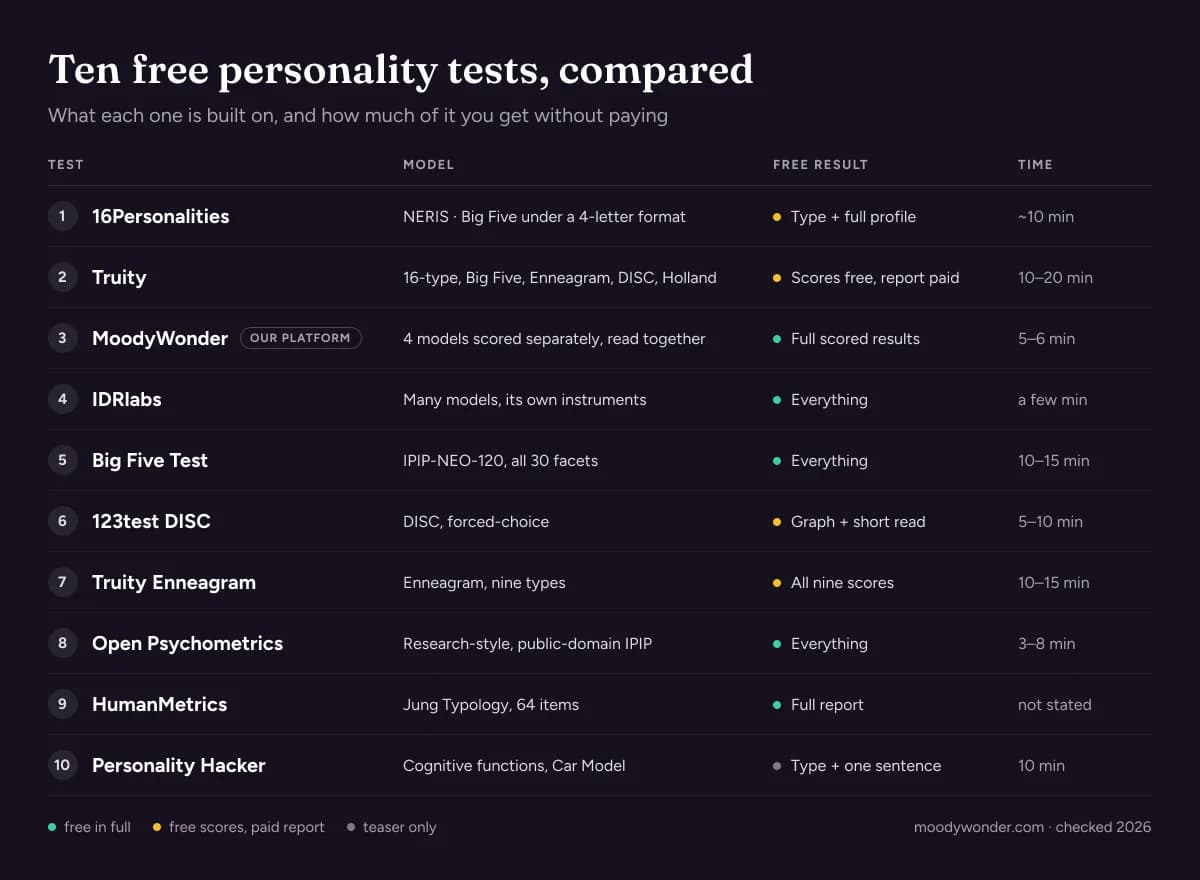
The ten tests at a glance
Ranked on the five criteria above. Every figure here was checked against each site's own pages in 2026 rather than carried over from an older review, and where a site does not publish a number we say so instead of estimating one.
- 1. 16Personalities — its own NERIS model, Big Five traits underneath a four-letter format · about 10 minutes · free type and a long free profile, with a paid suite on top · best for a first test that people around you will recognise.
- 2. Truity — many models in one place: 16-type, Big Five, Enneagram, DISC and Holland Code · 10 to 20 minutes depending on the test · free scored results, paid narrative reports · best for taking several different assessments without learning several different sites.
- 3. MoodyWonder — four models scored separately and read together, plus AI interpretation · 5 to 6 minutes per test · full scored results free, including percentiles · best for wanting more than one label. Our own platform; see the disclosure in the entry below.
- 4. IDRlabs — almost two thousand tests across many models, using its own instruments · usually a few minutes each · entirely free, no account · best for breadth, with the caveats below.
- 5. Big Five Test — Johnson's 120-item IPIP-NEO, the open-source workhorse of the field · 10 to 15 minutes · completely free, including all thirty facets · best for the most rigorous free result available anywhere.
- 6. 123test DISC — DISC, forced-choice · 5 to 10 minutes · free graph and short characterisation, extended report paid · best for a quick read on your workplace communication style.
- 7. Truity's Enneagram test — Enneagram, nine types across three centres · about 105 questions, 10 to 15 minutes · free scores on all nine types, paid full report · best for the motivation question. Listed separately from Truity itself because it is the free Enneagram most people land on.
- 8. Open Psychometrics — around thirty research-style tests, Big Five built on public-domain IPIP scales · the Big Five takes 3 to 8 minutes · free, no account, no ads, no upsell · best for wanting the instrument without the packaging.
- 9. HumanMetrics — Jung Typology Test, a four-letter type from a Jungian basis · 64 questions · free full report, other tests priced individually · best for a classic Jungian-style typing.
- 10. Personality Hacker — cognitive functions, taught through their Car Model · 60 questions, 10 minutes · free result is a type and one sentence · best for the teaching material rather than the test.
A trademark note, since this is where it matters most. The Myers-Briggs Type Indicator® is a commercial instrument published by The Myers-Briggs Company, and MBTI® and Myers-Briggs® are registered trademarks of the Myers & Briggs Foundation. The official assessment is not free — it starts at $59.95 through MBTIonline. Every four-letter test on this list, ours included, is an independent assessment inspired by the same underlying type theory. None of them are the MBTI® instrument, none are endorsed by The Myers-Briggs Company, and their results are not interchangeable with an official one.
The tests in detail
1. 16Personalities — the one everyone has taken
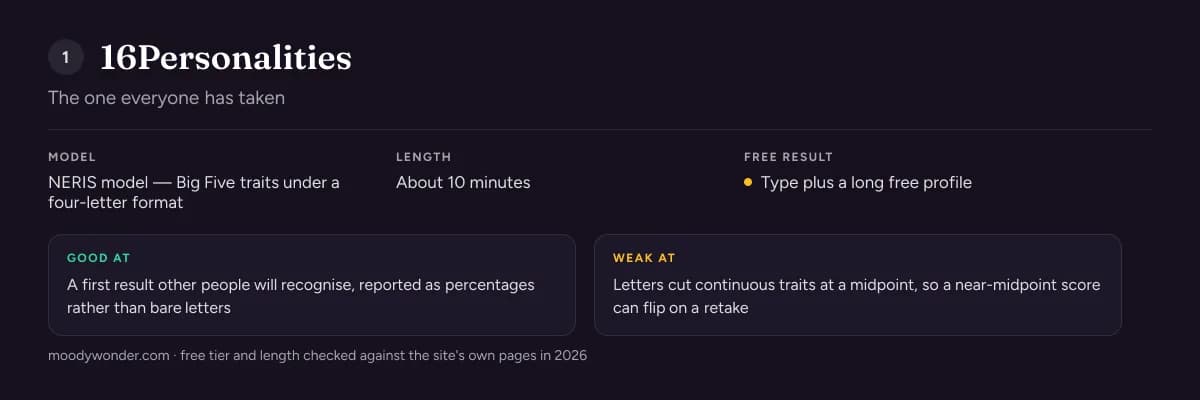
The most-used personality test on the internet, and the most widely misunderstood. It produces a four-letter type plus a fifth letter for Identity, Assertive or Turbulent, which is why people assume it is an MBTI-style Jungian test. It is not, and the site says so plainly: its NERIS model does not use cognitive functions, and its dimensions are a reworking of the Big Five traits. The four letters are a presentation format sitting on top of trait scores.
That combination is also why it works. You get the readability of a type and the honesty of continuous percentages, in a free profile long enough to be genuinely useful — strengths, weaknesses, workplace habits, relationships. The paid Career Suite, a one-time purchase, adds career material and AI mentors on top.
- Good at — a first test, and a result other people will recognise
- Weak at — stability. Cutting continuous traits into letters means anyone scoring near a midpoint can come back a different type on a retake, and the letters give no hint of how close the call was
- Free result — substantial
- Best for — beginners, and anyone who wants a common vocabulary rather than a measurement
2. Truity — the largest free assessment library
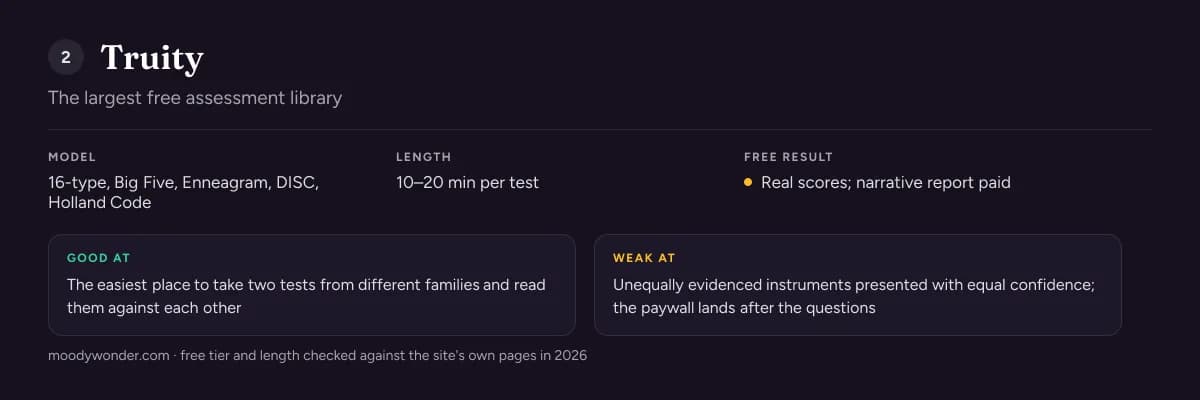
Truity's strength is range. TypeFinder for 16 types, a Big Five, an Enneagram, a DISC and a Holland Code career profiler all live under one account-free roof, which makes it the easiest place to do the thing we recommend most: take two tests from different families and read them against each other.
The consistent complaint is the timing of the paywall. Free gives you real scores — on the Enneagram test, your standing across all nine types plus a preview of the top one — while the narrative report, wings and growth material are paid, and you find that out after roughly 105 questions. No account is needed, and results are not emailed, so finish in one sitting.
- Good at — breadth, and clean scored output
- Weak at — signalling that its instruments are not equally well-founded — the Big Five and the Enneagram are presented with the same confidence despite standing on very different evidence
- Free result — scores yes, interpretation mostly no
- Best for — comparing several models without learning several sites
3. MoodyWonder — four models, read together
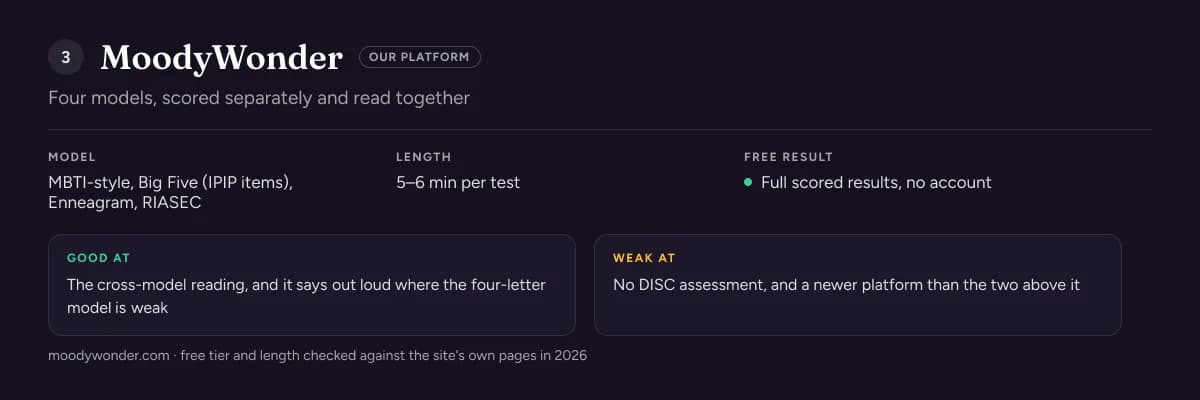
Disclosure: MoodyWonder is our own platform. We have included it because a comparison of multi-model free tests that omitted it would be odd, and we have tried to write this entry to the same standard as the other nine, including what it does not do.
The premise is that a single framework answers a single question, so the four run separately and are then read against each other: a 16-type test at 36 questions, a Big Five at 30 questions using items adapted from the public-domain IPIP pool, an Enneagram at 27 questions that reports your top three drives rather than crowning one, and a RIASEC career interest inventory at 36 questions. Each takes five or six minutes. Where the four-letter model is weak — near the middle of a dimension — the result says so and shows the dimensional scores instead of hiding them behind a label.
Every test and every core result is free: percentile scores, your archetype, the radar chart and a share card, with no account required to see them. The AI layer, which reads your actual numbers rather than generic type text, is free at five messages a day. Paid upgrades exist — a single deep report at $3.99, or unlimited AI coaching at $9.99 a month.
- Good at — the cross-model reading, and refusing to overclaim on the weaker frameworks
- Weak at — two things worth saying plainly. There is no DISC assessment, so if workplace communication style is your specific question, number six on this list serves you better. And it is a newer platform than 16Personalities or Truity, without their decade of iteration
- Free result — full scored results
- Best for — readers who want more than one label and want to know where the labels disagree
4. IDRlabs — breadth, with a caveat attached
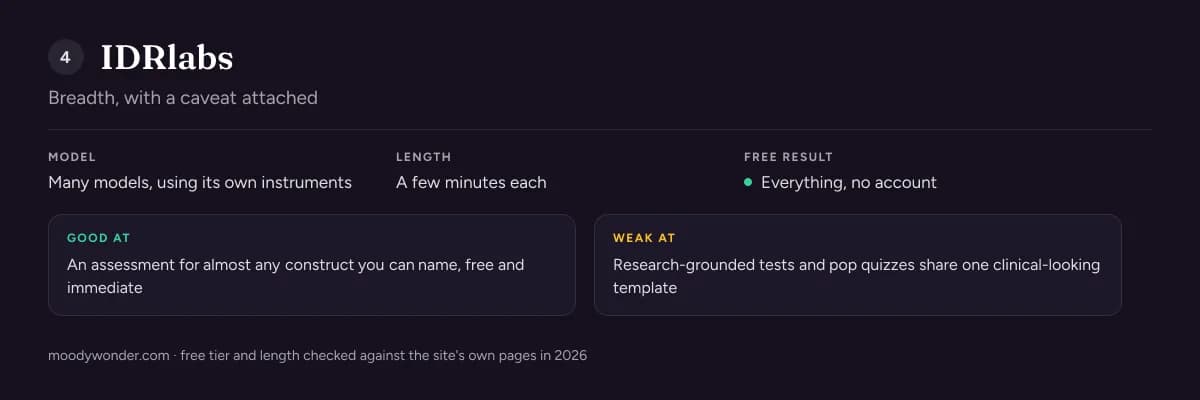
Close to two thousand tests, all free, no account, and no paywall anywhere. Big Five, Jungian typology, political coordinates, dark-triad scales and a large number of pop-culture quizzes, all presented in the same clinical template with the same percentile bar charts.
That uniform presentation is the problem. A test built on published research and a quiz about which cartoon character you resemble look identical, and nothing on the page tells you which you are taking. Its Big Five test uses IDRlabs' own instrument rather than the IPIP-NEO, a distinction the site does flag. The organisation behind it publishes little about itself — the site lists academic reviewers but no company details or named owner.
- Good at — finding an assessment for almost any construct you can name
- Weak at — letting you tell the rigorous ones from the entertainment
- Free result — everything, immediately
- Best for — curiosity and breadth, provided you check what a given test is actually built on
5. Big Five Test — the most rigorous free result on the list
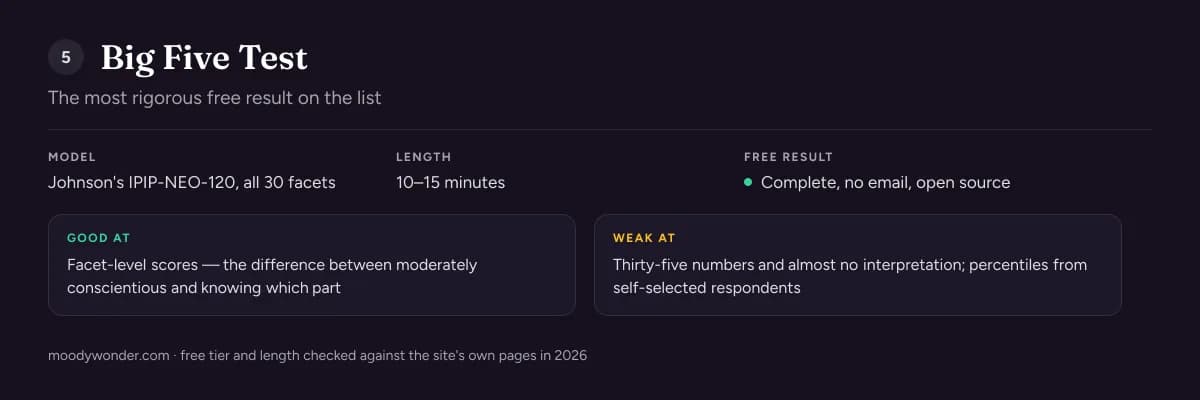
If you want one free test that a psychologist would not wince at, this is it. It runs Johnson's IPIP-NEO-120, a well-established public-domain instrument, and reports not just the five domains but all thirty facets underneath them — six per trait, each scored and described. That facet layer is the difference between "you are moderately conscientious" and knowing that your orderliness is low while your self-discipline is high, which are very different working lives.
It is free end to end. No account, no email, no upsell, and the code is open source. Results are retrievable later through a saved ID link, which is also the catch: lose the link and the result is gone.
- Good at — psychometric substance, at no cost, with no strings
- Weak at — presentation. You get thirty-five numbers with brief generic descriptions, no narrative and no guidance on what to do next. Its percentiles are also drawn from self-selected internet respondents rather than a representative population sample
- Free result — complete
- Best for — anyone who wants the data and is willing to do the interpreting
6. 123test DISC — the practical workplace read
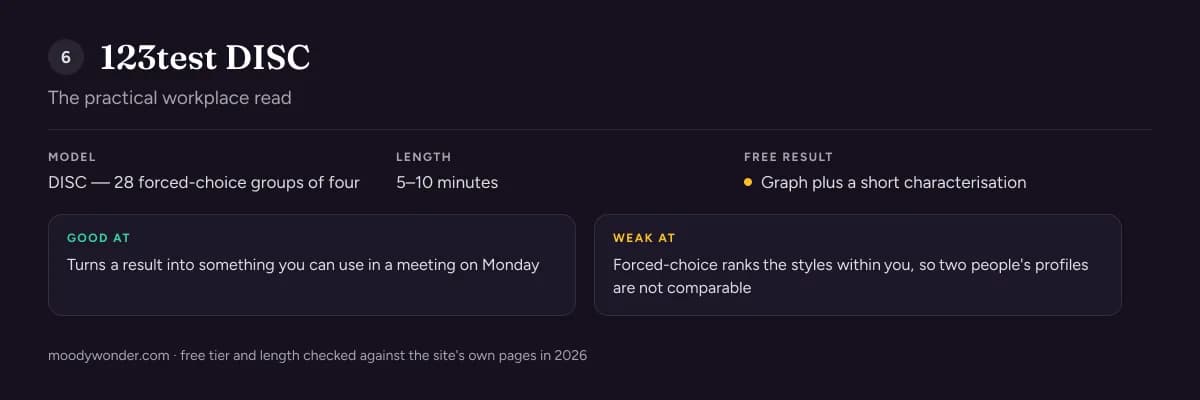
Twenty-eight groups of four statements, forced-choice, five to ten minutes, and out comes a DISC profile: dominance, influence, steadiness and compliance. The free version gives you the graph and a short characterisation of your profile; the fourteen-page extended report with pattern classification, workplace tactics and a PDF is paid, and the standalone price is not shown until checkout.
123test is the most transparent operator on this list about who it is — a Netherlands company with a named team and published credentials, running its own validation work. Set against that, the site runs near-permanent discount campaigns that sit oddly with the clinical framing.
- Good at — turning a result into something you can use in a meeting on Monday
- Weak at — a limitation shared by most DISC instruments and not flagged in the free report — the forced-choice format ranks the four styles within you, so your profile is not straightforwardly comparable with a colleague's, which is exactly what team workshops tend to do with it
- Free result — a real but brief read
- Best for — communication and team-role questions
7. Truity's Enneagram test — the motivation question
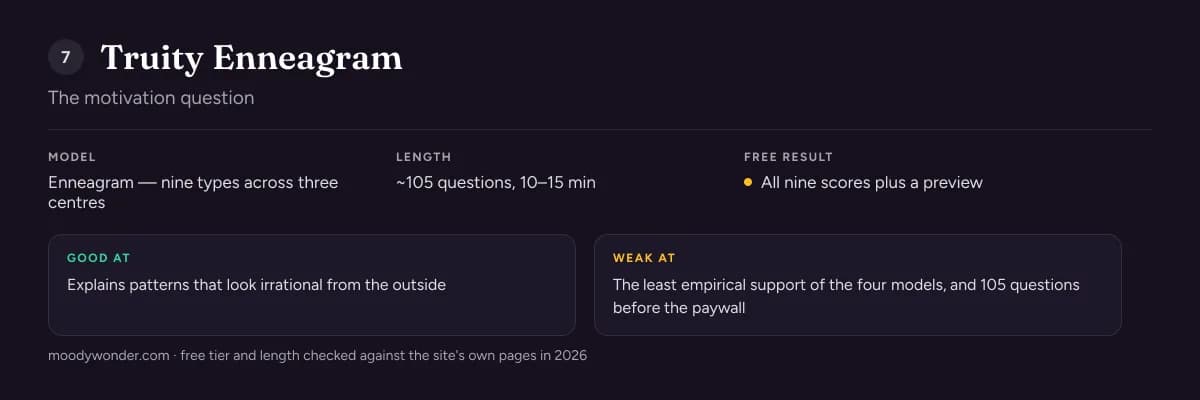
The Enneagram asks something the other frameworks skip: not how you behave, but what you are moving toward or away from when you do. Nine types, each defined by a core desire and a core fear, grouped into three centres. Truity's version runs about 105 questions in 10 to 15 minutes and returns free scores across all nine types, which is more informative than a single crowned type — most people load onto two or three.
Treat the output differently from a Big Five score. The Enneagram has the least empirical support of the four common models, and its interpretive richness is also what makes it hard to test. It is a language for motivation rather than a measurement of it, and it earns its place on this list because no other framework here does that job at all.
- Good at — explaining patterns that look irrational from outside
- Weak at — falsifiability, and the paywall arriving after 105 questions
- Free result — all nine scores, plus a preview
- Best for — the why behind a behaviour you already know you have
8. Open Psychometrics — the instrument without the packaging
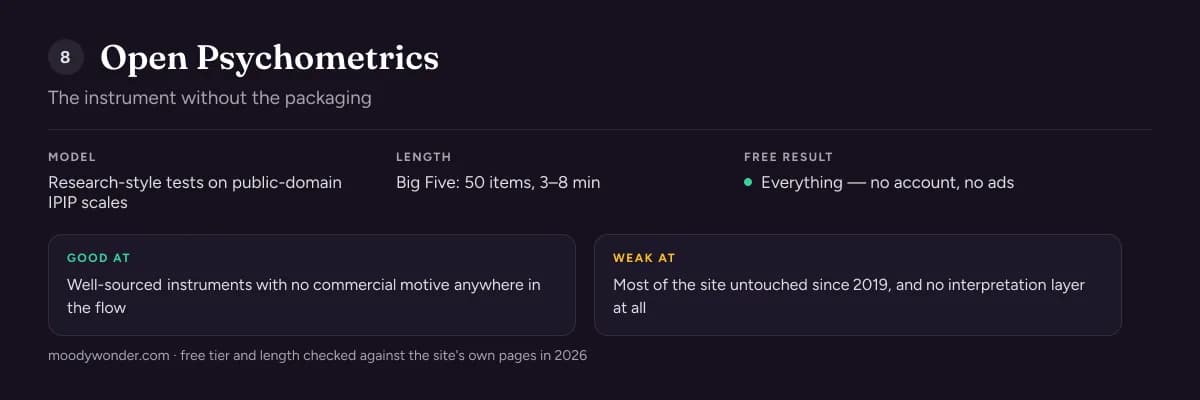
An academic-feeling archive of around thirty tests, free, no account, no advertising and no upsell of any kind. Its Big Five uses public-domain IPIP scales, runs fifty items, and takes most people three to eight minutes. It also releases anonymised datasets for public research use, which is unusual and genuinely valuable.
Be clear-eyed about its state, though. Most of the site — the index pages, the Big Five test itself, the data archive — has not been updated since 2019, and the dataset releases have been dormant for years. Only its statistical character quiz is still actively maintained. The site's own disclaimer says the tests are for educational and entertainment use and are not clinically administered.
- Good at — unadorned, well-sourced instruments with no commercial motive anywhere in the flow
- Weak at — interpretation, design, and being currently maintained
- Free result — everything
- Best for — the psychometrically curious
9. HumanMetrics — the classic Jungian typing
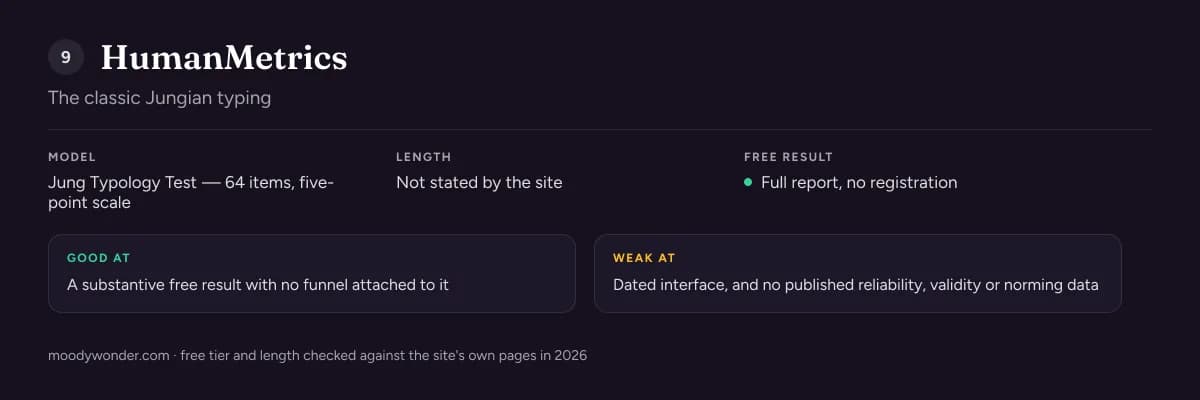
Running since 1998, and it looks it. The Jung Typology Test is 64 items on a five-point scale, presented on one long page with no progress bar, and returns a four-letter type with preference strengths, a type description, communication and learning styles, behaviour under stress and career suggestions — a fuller free report than several better-looking sites offer. No registration is needed. Their other assessments are paid individually, in the three-to-nine-dollar range, through prepaid credit. A newer AI assistant has been grafted onto the front.
- Good at — a substantive free Jungian-style result with no funnel attached
- Weak at — everything about the presentation, and the absence of any published reliability, validity or norming data. A small tell: its own trademark disclaimer still names CPP, Inc., a company that changed its name to The Myers-Briggs Company in 2018 — a page nobody has read in a long time
- Free result — generous
- Best for — readers who want the classic typing and do not care what it looks like
10. Personality Hacker — a teaching business with a test attached
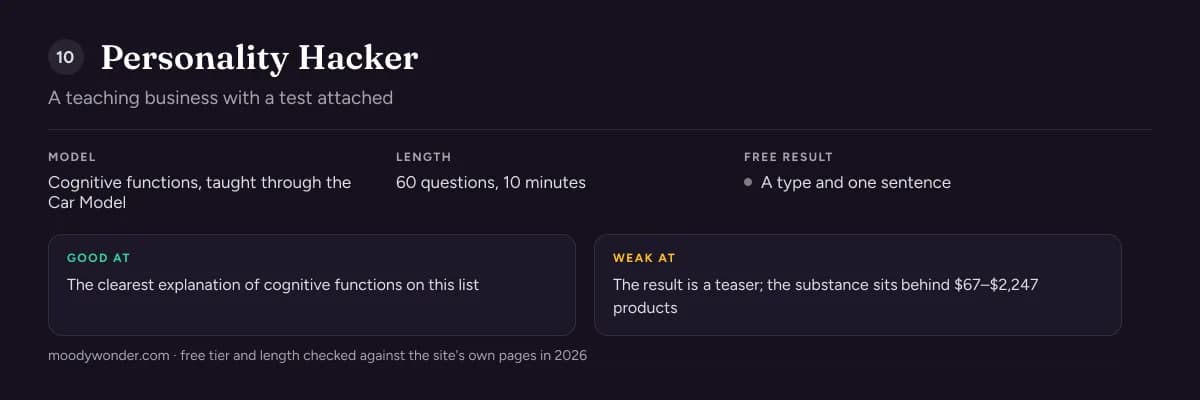
The framing is cognitive functions rather than letters, taught through their Car Model — your dominant function as the driver, the supporting one as the copilot, and two less developed ones as passengers. It is a genuinely useful teaching device, and their podcast and articles are the most substantial free content of anyone on this list.
The test is not why you would come here. Sixty forced-choice questions, ten minutes, and the free result is your four-letter type plus a single sentence, after which the material sits behind products ranging from a $67 course to mentorship in the low four figures. The type page's free guide costs an email and a twice-weekly mailing list. Their proprietary names for the cognitive functions also make their material hard to cross-reference against any other source.
- Good at — explaining cognitive functions to someone who found them impenetrable elsewhere
- Weak at — being an assessment
- Free result — a type and a sentence
- Best for — the reading, not the testing
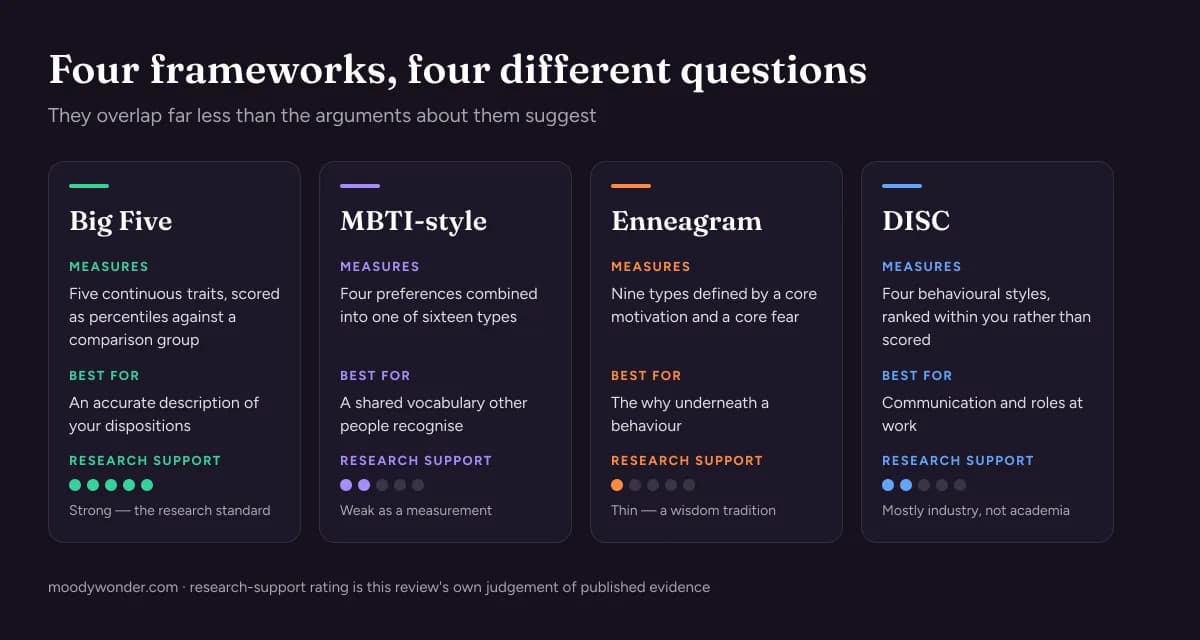
MBTI vs Big Five vs Enneagram vs DISC
The four frameworks are not four answers to one question; they are four different questions. Choosing well is mostly a matter of knowing which one you are actually asking.
The Big Five (OCEAN)
- What it measures: five continuous traits — openness, conscientiousness, extraversion, agreeableness and neuroticism — reported as percentiles against a comparison group rather than as a category.
- Best for: an accurate description of your dispositions, and any question where being right matters more than being memorable.
- Research support: the strongest of the four. It emerged from statistical analysis rather than from a theory someone proposed, replicates across languages, and is the model behind most published personality research.
- The catch: five numbers are hard to hold in your head and harder to talk about at dinner. Accuracy is not the same as usefulness, and the Big Five needs interpretation to become either.
MBTI and MBTI-style type tests
- What it measures: four preferences — where you get energy, how you take in information, how you decide, how you organise the outside world — combined into one of sixteen types.
- Best for: a shared vocabulary. The reason sixteen types outlived their critics is that "I'm an INFJ" starts a conversation in a way that "I'm at the 68th percentile for openness" does not.
- Research support: weak as a measurement. The main criticisms are the discrete categories and the number of people who get a different type on a retake, both of which follow from cutting continuous dimensions at a midpoint.
- The catch: the letter hides the margin. Two people with the same four letters can be very different, and someone who scored 51/49 on a dimension is described as though they scored 90/10. Any type test worth taking shows you how strong each preference was.
The Enneagram
- What it measures: nine types defined by a core motivation and a core fear, plus how each one shifts under stress and in security.
- Best for: the question of why. It is the only common framework that treats the driver behind the behaviour as the main object, which makes it unusually good at explaining patterns that look irrational from the outside.
- Research support: the thinnest of the four. It comes from a wisdom tradition rather than a laboratory, and the published validation work is limited.
- The catch: the interpretive freedom that makes it feel accurate is also what makes it hard to falsify. Read it as a language for motivation, not as a measurement of one.
DISC
- What it measures: four behavioural styles — dominance, influence, steadiness and conscientiousness — describing how you tend to act in a work setting.
- Best for: communication at work. It is deliberately narrow, and the narrowness is why it is the most immediately actionable of the four: it tells you how to open a conversation with someone whose style differs from yours.
- Research support: developed largely inside corporate training rather than academic psychology. Individual publishers run their own validation studies; the model as a whole does not have the standing of the Big Five.
- The catch: most DISC instruments use a forced-choice format that ranks the four styles within you. That makes your profile a statement about your own priorities, not a score that can be meaningfully compared against a colleague's — which is, awkwardly, exactly what team workshops tend to do with it.
Combining frameworks is more informative than picking a winner, and this is the strongest argument against treating any single result as your personality. A Big Five profile tells you how much of a trait you have; an Enneagram type suggests what you are trying to get or avoid when you use it; a DISC style predicts how that lands on a colleague. The same person can be high in conscientiousness, driven by a fear of being unremarkable, and read as blunt in meetings — and no single test would have shown you all three.
Are free personality tests accurate?
Accurate enough to be worth taking, and not accurate enough to be treated as fact. That is an unsatisfying answer, so here is what it rests on.
The price of an assessment mostly does not reflect the quality of its questions. Several of the best-validated item pools in psychology — the IPIP among them — are public domain, which means a free test can be built on exactly the same foundation as a paid one. What you pay for in a commercial instrument is the interpretive report, the certified practitioner reading it, and the legal cover an employer wants. Those are real things; they are not accuracy.
What genuinely limits these tests is more interesting than cost:
- They measure self-description, not behaviour. You are reporting who you believe you are, and the gap between that and what you do is not small.
- They measure a day. Mood, sleep, a bad week at work and how recently you argued with someone all move scores, which is why a result that shifts on a retake is usually a fact about the week rather than an error.
- Personality changes, slowly. Longitudinal research finds most people become somewhat more conscientious and emotionally stable through their twenties and thirties, so a result from five years ago describes someone slightly different.
- Context is invisible to the test. Nobody has one personality at work, with their parents, and at 2am with an old friend, and a questionnaire has no way of knowing which one you had in mind.
The productive way to hold a result is as a hypothesis. A score that surprises you is worth more than one that confirms you — it is the only part of the report that told you something. If you want the statistical version of this argument, we wrote about reading a percentile without panicking, and the knowledge base entry on percentiles and norms covers where the comparison group comes from.
How to choose the right personality test
- Start from the question, not the test. "Why do I keep clashing with my manager" and "what should I study" are different problems, and they point at different models. Picking a famous test first and hoping it answers your question is how people end up with a four-letter code and no plan.
- Match the model to the question. Traits and self-understanding: Big Five. A shared language for how you think: an MBTI-style test. Motivation and recurring emotional patterns: Enneagram. Workplace communication: DISC. Career direction: a RIASEC interest inventory.
- Check what the free result includes before you start. Twenty minutes of questions followed by a paywall is the most common bad experience in this category, and it is entirely avoidable.
- Take two, from different families. One trait test and one type or motivation test will disagree in places, and the disagreement is the most informative part — it is usually pointing at a difference between how you see yourself and how you behave.
- Read for the verbs, not the noun. The useful sentence in any report is the one that describes something you do in a situation. The label is a filing system; the behaviour is the content.
Two related pieces if you want to go further: our guide to what a characteristics test actually measures, and a narrower list of tests for understanding your attachment style if relationships are the reason you started looking. The sixteen type profiles are free to read without taking anything.
How we compared these
Each site was reviewed in 2026 against its own published material — the test pages, the pricing pages, the documentation of what the free tier includes, and in most cases the questionnaire itself. Where a site does not publish something, we say that rather than filling the gap: 123test's standalone extended-report price, for instance, appears only at checkout, so we have not quoted a figure for it.
Rankings weigh scientific grounding, what the free result actually contains, depth of interpretation, and how honestly a site describes its own limits. That last criterion matters more than it sounds. A test that overclaims about its evidence is telling you, in advance, how it will handle the parts of your result it cannot support.
Pricing on several of these platforms moves, and free tiers move with it. Treat any figure here as a checkpoint rather than a quote, and check the site before you decide.
And the disclosure again, since this is where a reader who skipped the introduction will arrive: MoodyWonder is our own product, ranked third on our own list. The entry above says what it does not do, and every claim in it is checkable on the free tier without an account.
If you want to start somewhere rather than read another comparison, the Big Five test is the one we would point almost anyone to first: five minutes, honest percentiles, and the results the rest of the field is measured against.