Three years ago this job did not have a name. Now there are conference tracks about it, agencies that sell it and job adverts that ask for it, usually under a slightly different label each time. Generative engine optimization, or GEO, is the work of getting a business, a product or a source named and cited inside the answers that ChatGPT, Gemini, Perplexity and Google's AI summaries give.
It is easy to describe the work in hype or in dismissal. Neither helps someone deciding whether to move into it. The more useful questions are what the work actually consists of on an ordinary Tuesday, what kind of person finds that satisfying, and how to find out before betting a career on it.
18%
of Google searches in a March 2025 Pew sample produced an AI summary
up to 40%
visibility gain inside AI answers from writing changes, in the paper that named GEO
$78,760
2025 median pay for the wider U.S. marketing analyst and specialist group
Each of those numbers explains part of why the job exists. AI summaries now sit on top of a meaningful share of searches, so businesses that used to compete for a click now compete to be mentioned in a paragraph. Research has shown that how a page is written changes whether it gets quoted. And the wider occupational family that this work belongs to is well paid and growing.
What a GEO specialist actually does
The clearest official description of the neighbouring job comes from O*NET, the occupational database maintained for the U.S. Department of Labor. Its profile of search marketing strategists lists tasks that a GEO specialist would recognise immediately: tracking and reporting search activity, analysing web metrics, optimizing text and other assets so engines can find and use them, and working with developers on how a site is built. GEO adds a layer on top of that list rather than replacing it.
In practice the added layer has four parts.
The first is measurement. A GEO specialist builds a set of questions that real customers ask, puts them to several AI engines on a schedule and records which businesses get named, how often and with which sources cited. This is harder than it sounds, because the same question can produce a different answer each time, and a single answer proves very little.
The second is source work. AI engines cite pages, and the specialist studies which pages get cited for a topic and why. Sometimes the answer is the business's own site. Often it is a review, a comparison page or a news article on someone else's domain, which turns part of the job into earning that third party coverage.
The third is writing for extraction. A page written to persuade a human reader slowly is not always a page an AI engine can lift a clean sentence from. The specialist rewrites key pages so the main claims are stated plainly, near the top and with their evidence attached.
The fourth is technical access. If AI crawlers are blocked by a site's settings, or the content only appears after code runs in a browser, the best writing in the world will not be retrieved. Checking that the door is open is unglamorous and often the single most valuable fix.
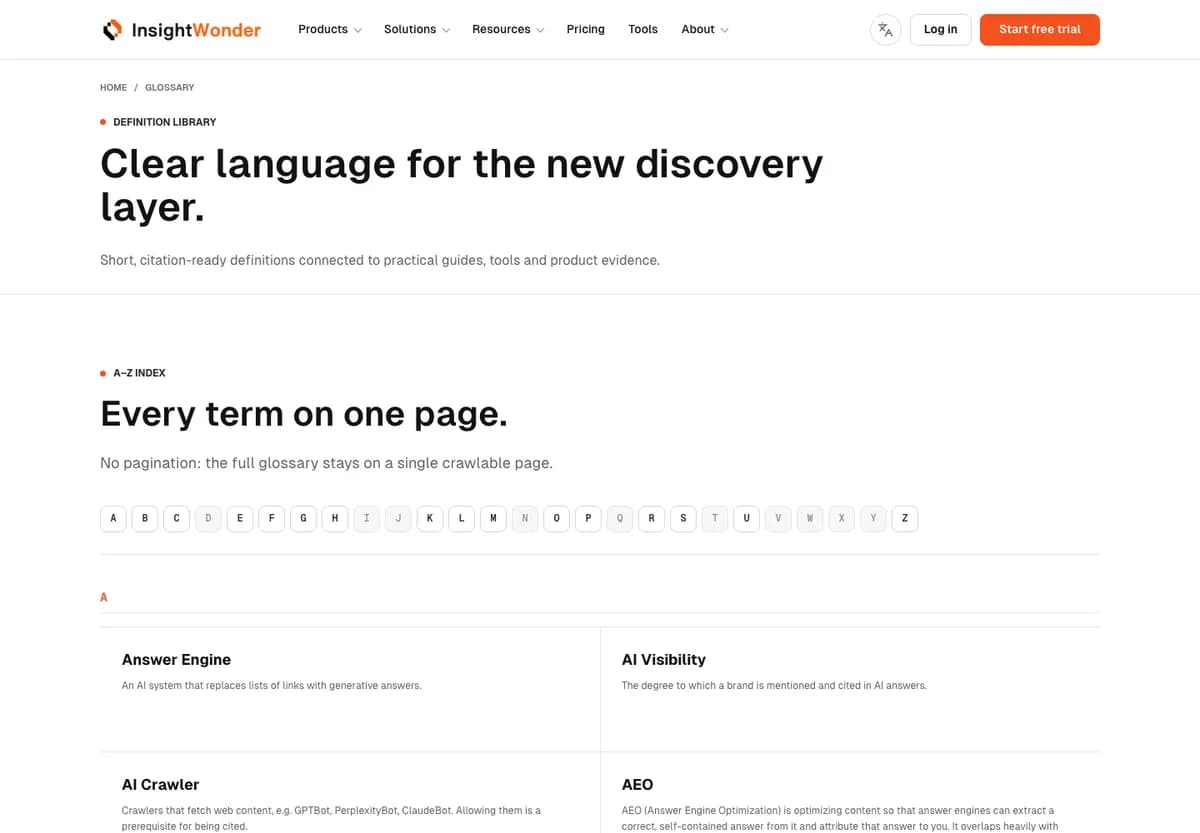
A newcomer meets a wall of acronyms first. InsightWonder's definition of GEO is short and precise: getting a brand mentioned, cited and recommended in AI generative answers. Its guide to which term means what sorts out GEO, AEO, LLMO and AI SEO, which are used inconsistently across the industry and are worth separating before reading job adverts.
What an ordinary week looks like
Descriptions of a job tend to list its most interesting tasks. A more honest picture is a typical week, including the dull parts, and the shape below is a composite of how GEO work is usually organised rather than any one person's diary.
Monday is a measurement run. The same few dozen customer questions go to several AI engines, and the answers are logged: who was named, in what order, which pages were cited. Most of the morning is spent cleaning the results, because engines phrase brand names inconsistently and the same business can appear under three spellings.
Tuesday is source analysis. The specialist looks at the pages that keep getting cited for the client's topic and asks what they have in common. Often the answer is uncomfortable. A competitor is cited because a well known review site wrote about them two years ago, and no amount of rewriting the client's own pages will change that quickly.
Wednesday is writing. One important page gets rewritten so its central claims are stated plainly and early, each with evidence attached. InsightWonder's guide to writing so an answer can be lifted out describes the technique, and it is closer to good technical writing than to marketing copy.
Thursday is plumbing. A check of the site's crawler settings, a look at whether the important content appears without scripts running, a review of the structured data. The guide to letting AI crawlers in covers the checks that matter. This is the day most likely to produce a large improvement from a small change.
Friday is reporting, and it is where many people discover whether the job suits them. The numbers moved, some up and some down, and most of the movement is noise. The report has to say so without sounding evasive, and still recommend what to do next.
How GEO differs from SEO
Search engine optimization and GEO share most of their foundations, and many people doing GEO work today came from SEO. The differences are real, though, and they change what a working day feels like.
The row about variability matters most for temperament. A ranking report is usually a reassuring document; a GEO report is a probability estimate with error bars, and the specialist spends a good part of the job explaining why a number moved when nothing changed. InsightWonder's guide to GEO versus SEO covers what carries over and what does not, and it is a fair description of the transition many SEO people are making now.
The interests the work rewards
Vocational psychology has a well tested way of describing the kinds of work people find engaging. John Holland's model sorts work interests into six types: Realistic, Investigative, Artistic, Social, Enterprising and Conventional, often shortened to RIASEC. Most people and most jobs are a blend of two or three.
O*NET gives search marketing strategists the interest code ECI. That is Enterprising first, then Conventional, then Investigative, and it describes the GEO version of the job well.
| Interest | What it means in this job | A sign it fits | A sign it may not |
|---|---|---|---|
| Enterprising | Persuading, competing for attention, linking work to business results | Caring whether a client actually wins visibility | Finding commercial goals distasteful |
| Conventional | Working with data, procedures, consistent records | Enjoying a well built tracking sheet | Wanting every week to look different |
| Investigative | Analysing, testing ideas, explaining why something happened | Wanting to know why an engine cited one page and not another | Losing interest once the answer is a probability |
What is missing from that code is as informative as what is present. Artistic is not in it, even though the job involves writing; the writing is in service of clarity and extraction rather than expression. Social is not in it either, although client communication is part of agency work. Someone whose strongest interests are Artistic and Social may enjoy the content side of the field and find the measurement side draining.
The Career Interest Match test on this site scores all six RIASEC types and reports the top combination. An Enterprising and Investigative profile, or a Conventional and Investigative one, is the pattern this job most often fits. The piece on using the RIASEC model to choose a first job explains how to read a combination rather than a single letter.
Why interest fit matters at all
It would be reasonable to wonder whether any of this predicts anything. It does, more than most people assume.
In 2012 Christopher Nye, Rong Su, James Rounds and Fritz Drasgow pooled 60 studies and roughly 568 correlations spanning more than six decades of research on vocational interests. They found that interests are related to both performance and persistence at work and in education, and that measures of fit between a person's interests and their occupation predicted performance more strongly than interest scores on their own. That is the practical case for checking a profile before switching fields. Fit does not guarantee success, and it does tilt the odds toward staying long enough to become good.
The traits that help, and the ones that get in the way
Interests describe what someone finds engaging. Traits describe how they tend to behave while doing it, and O*NET lists the work styles this occupation leans on: innovation, adaptability, achievement orientation, intellectual curiosity, attention to detail and dependability.
Translated into the Big Five vocabulary, that list points toward two traits more than the others. Intellectual curiosity and innovation sit close to openness to experience, the trait that makes a new and poorly mapped field feel interesting rather than threatening. Attention to detail and dependability sit close to conscientiousness, which is what keeps a measurement programme honest when the results are noisy and the temptation is to cherry pick a good week.
Two other qualities matter here more than in many marketing roles, and neither appears neatly in a trait list.
One is tolerance for ambiguity. AI engines change their behaviour without announcement, and a specialist has to act on incomplete evidence while saying clearly how incomplete it is. People who need firm answers before they move tend to find the field exhausting.
The other is a kind of professional honesty under pressure. When a client wants proof that their visibility rose, the easy move is to report the best run and ignore the others. InsightWonder's guide to measuring change over time is largely about resisting that move, and the people who last in this work tend to be the ones who would rather report a disappointing true number than an impressive false one.
The Work Style test on this site looks at how someone plans, decides and collaborates, which is a reasonable complement to an interest profile when the question is whether a role would suit day to day.
Agency, in house or freelance
The same skills feel quite different depending on where the work is done, and the setting is worth choosing as deliberately as the field.
At an agency the specialist runs several clients at once. The pace is fast, the variety is high and a large share of the week is communication: explaining results, managing expectations, defending a measurement method to someone who wanted a bigger number. People with strong Enterprising and Social interests tend to enjoy this. People who prefer to go deep on one problem tend to find the context switching tiring.
In house, the specialist works for one business and usually sits inside a marketing or content team. There is more time for depth, more access to the product and the data, and more patience for slow projects such as earning third party coverage. The Conventional and Investigative side of the ECI profile is more at home here.
Freelance work combines the hardest parts of both. It needs the analytical skills of the in house role and the selling skills of the agency, plus the self direction to keep going without anyone setting deadlines. The Leadership Potential test is a reasonable rough check on whether running a one person practice would energise or drain someone, although no questionnaire substitutes for a trial project.
What the job is not
It is not a trick for gaming chatbots. There is no reliable hidden phrase that makes an AI engine recommend a business, and the research that gave the field its name worked by making true content clearer and better sourced, not by inserting anything deceptive.
It is not a replacement for having something worth recommending. A specialist can make a good product easier to find and cite. Making a weak product look strong in AI answers is short lived, because engines increasingly weigh what independent sources say, which is why InsightWonder's guide to third party corroboration describes it as the work that cannot be done on a business's own domain.
And it is not yet a settled profession with a standard path into it. There is no dominant certificate, job titles vary widely and many employers advertise the work under older names. That is an opportunity for someone who likes defining a role, and a frustration for someone who wants a clear ladder.
How to test the fit before changing careers
The cheapest experiment is to do a small version of the job on a site someone already knows well, perhaps a friend's business, a club or a personal blog.
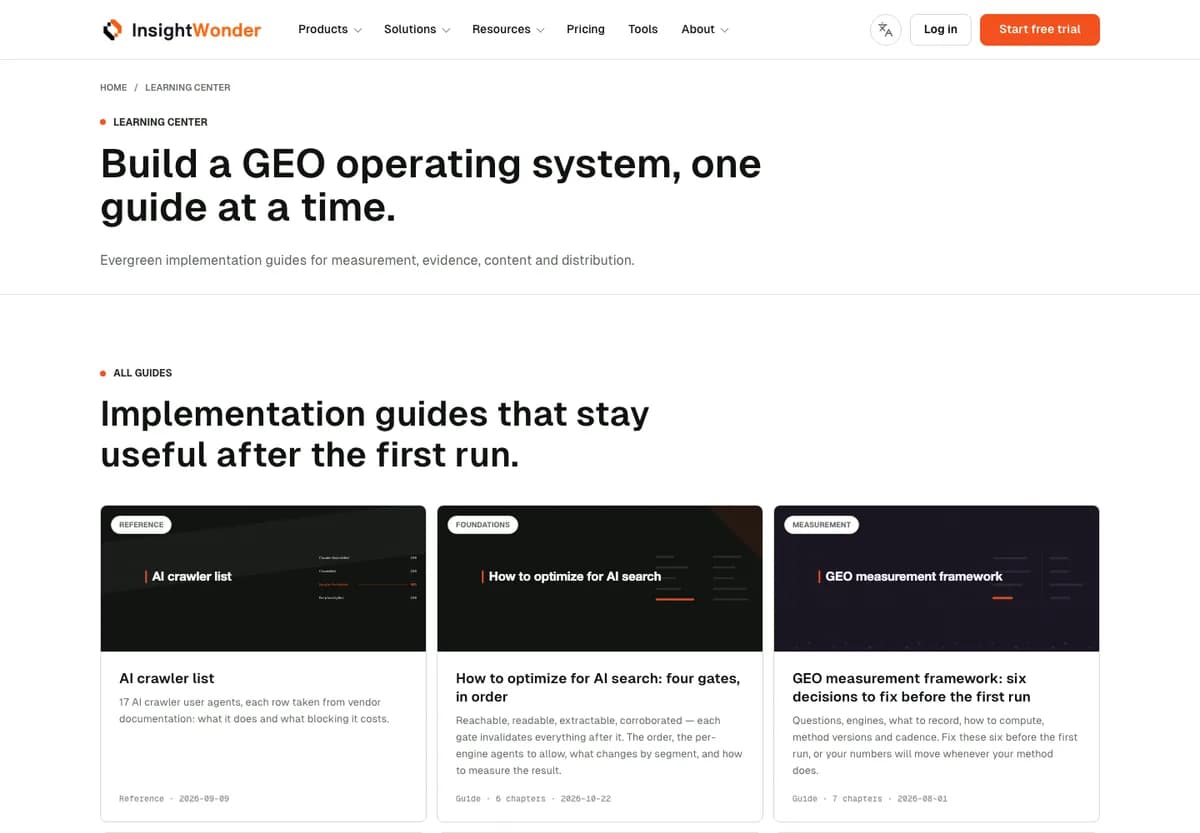
InsightWonder's learning center is a reasonable syllabus for that experiment, because its guides are ordered roughly the way a project runs: access first, then measurement, then content. Its free tools need no account and include a snapshot of whether an AI engine mentions a site, a check on whether AI crawlers can reach it and a review of a page's structured data. A weekend spent running those checks, writing down what they show and rewriting one page for clarity is a close imitation of the real work.
The useful question afterwards is not whether the results improved, because a weekend is too short to show that. It is whether the process was absorbing. Did the inconsistent answers feel like a puzzle or like noise? Was the spreadsheet satisfying or tedious? Was explaining the findings to the site's owner enjoyable or a chore? Those reactions are a better predictor than any description of the job, including this one.
The skills worth building first
For someone starting from outside marketing, the order matters, because the AI specific skills sit on top of older ones.
Search fundamentals come first: how pages are discovered, indexed and ranked, and why some are trusted more than others. Nearly every GEO technique is an adaptation of something from search.
Analytics comes second, and in practice that means spreadsheets more than dashboards. Most of the measurement work is collecting messy results and summarising them without fooling oneself, which is a skill that transfers from almost any analytical job.
Clear writing comes third. Not persuasive copywriting, but the plain, front loaded, well sourced style that a reader in a hurry and a machine looking for a quotable sentence both reward.
A little technical literacy comes fourth: enough to read a robots file, inspect a page's structured data and recognise when content only appears after a script runs. None of this requires programming, and all of it can be learned from free documentation.
A working intuition for statistics runs underneath everything. Knowing that one run proves little, that a change needs repeated measurement to be believed and that a small sample can mislead is the difference between a specialist and someone who reports noise as progress.
Pay and outlook, read carefully
O*NET does not publish pay for search marketing strategists as a separate figure. It reports them within the wider group of market research analysts and marketing specialists, which had a 2025 median wage of $78,760 a year, about 952,700 jobs and a projected growth rate it classes as much faster than average. That group includes many roles that have nothing to do with AI search, so it is a context for the field rather than a forecast for it.
There is no reliable public count of GEO jobs. Advertisements use too many different titles, and the work is often one responsibility inside a broader content or search role. Anyone quoting a precise number for GEO salaries or openings is usually extrapolating from a small sample of job posts.
What can be said with confidence is the direction. Pew's 2025 research found that people click through to ordinary search results about half as often when an AI summary appears, and businesses that relied on those clicks now have a concrete reason to care whether they are named in the summary. That pressure is unlikely to reverse.
Who tends to thrive, and who tends to leave
The people who do well in GEO usually share a profile that looks slightly contradictory on paper. They are commercially minded enough to care about a client's results and scientifically minded enough to distrust their own good news. They like systems and can live with a system that keeps changing underneath them.
The people who leave tend to fall into two groups. Some wanted a creative writing job and found the writing too constrained by extraction and evidence. Others wanted a precise technical job and found the measurements too noisy to feel like engineering.
Career changers often arrive from directions that look unrelated and turn out not to be. Journalists bring the habit of checking a source before repeating it and of leading with the point. Librarians and researchers bring a feel for how information is organised and found. Data analysts bring the measurement discipline the field most often lacks. Teachers bring the ability to explain an uncertain result to someone who wanted a certain one. Each of those backgrounds covers one or two parts of the job well and leaves a gap elsewhere, which is why a profile of interests and work style is more useful than a job title when deciding whether the move makes sense.
Neither reaction is a failure. Both are useful information, and they are the same information an interest and work style profile tries to surface in advance. The entry on work and identity is about why that matters: the jobs people stay in are usually the ones that fit how they already like to spend their attention.
Sources
- O*NET OnLine (2026). Summary report for 13-1161.01 Search Marketing Strategists. U.S. Department of Labor, Employment and Training Administration.
- Pew Research Center (2025). Google users are less likely to click on links when an AI summary appears in the results.
- Aggarwal, P., Murahari, V., Rajpurohit, T., Kalyan, A., Narasimhan, K., Deshpande, A. (2024). GEO: generative engine optimization. Proceedings of KDD 2024.
- Nye, C. D., Su, R., Rounds, J., Drasgow, F. (2012). Vocational interests and performance: a quantitative summary of over 60 years of research. Perspectives on Psychological Science, 7(4).
- O*NET Resource Center. O*NET Interest Profiler manual, documenting the RIASEC interest model based on Holland's theory.