A box under a test result says Recommended for you and offers a course, a book or a tool. Sometimes the recommendation is simply editorial. Often it is an affiliate link, which means that if the reader buys, the site that made the recommendation is paid a commission.
There is nothing hidden about the arrangement in principle. In practice most readers have only a vague idea of what happens after the click, who gets paid, how they know, and whether the money changes the recommendation. Those are fair questions, and they have plain answers.
30 days
the cookie window in Coursera's affiliate program, a typical length
15 to 45%
the commission range Coursera publishes for eligible purchases
2023
the year the FTC last revised its rules on endorsements and disclosure
What happens between the click and the commission
An affiliate link is an ordinary link with an identifier attached. The identifier says which publisher sent the visitor. Everything else follows from the seller recording that identifier and connecting it to a purchase.
| Step | What happens | What it means for the reader |
|---|---|---|
| Click | The link carries the publisher's identifier to the seller's site | Nothing visible changes for the buyer |
| Tracking | The seller stores the identifier, usually in a first party cookie | Clearing cookies or switching devices can break the link |
| Purchase | A sale within the cookie window is matched to the identifier | Buying weeks later can still count |
| Attribution | If several publishers sent the same buyer, a rule picks one | Usually the last click before purchase wins |
| Hold | The commission waits in a pending state | A refund inside the window cancels it |
| Payout | After the hold, the commission is paid in a batch | The buyer is not involved at all |
None of these steps adds anything to the price in most programs, because the commission is paid out of the seller's marketing budget. That is one of the few points on which affiliate programs are nearly uniform.
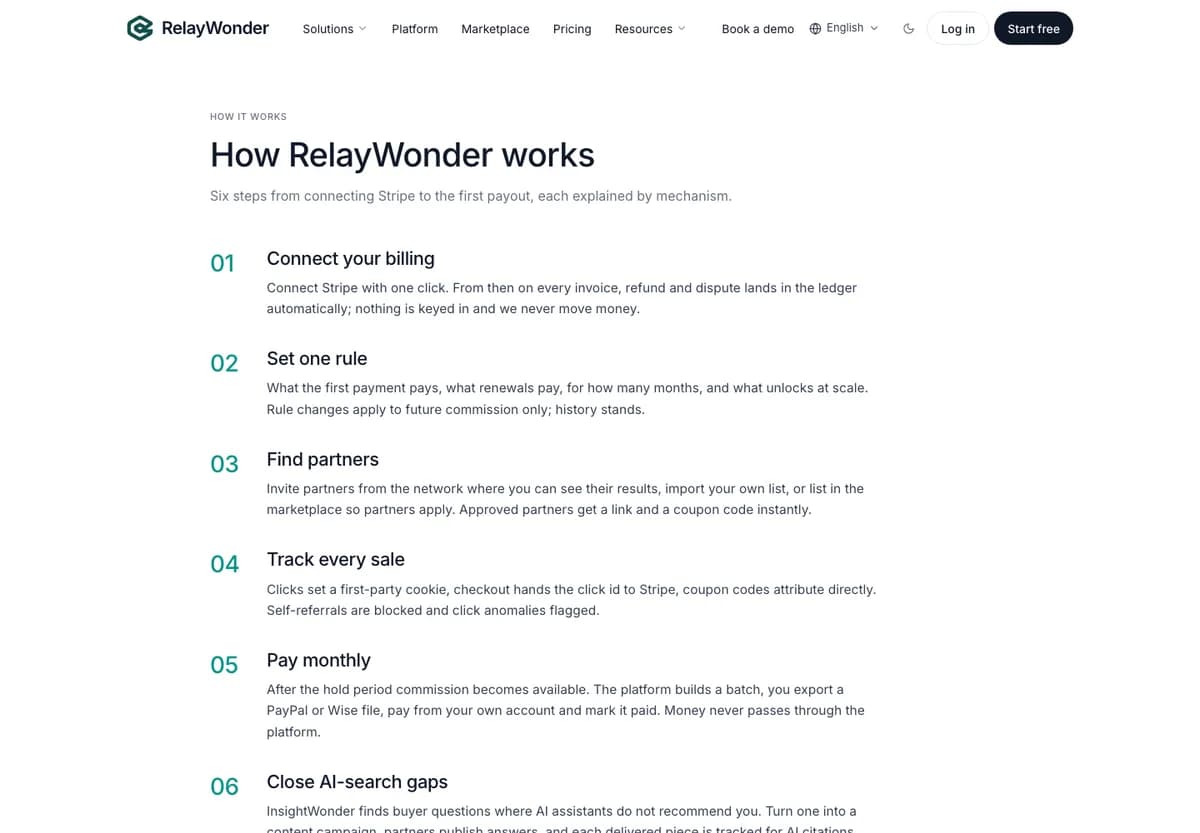
RelayWonder's how it works page is unusually specific about the plumbing. Clicks set a first party cookie, the click identifier is handed to the payment processor at checkout and coupon codes attribute directly, while self referrals are blocked and unusual click patterns are flagged. It also states that money never passes through the platform: the seller pays partners from its own account after the hold period. That detail is worth noticing because it answers a common worry about who holds the money in between.
Who pays, and why the price usually stays the same
Sellers pay commissions because affiliate marketing is one of the few kinds of advertising where they pay only for results. A banner advertisement costs money whether or not anyone buys. An affiliate commission is owed only after a sale, and only after the hold period has passed without a refund. For a seller, that makes the commission a cost of acquiring a customer, budgeted alongside every other marketing expense, rather than a surcharge on the product.
The structure of the commission varies with what is being sold. A one time purchase usually pays a percentage of the order. A subscription can pay in one of two ways: a share of the first payment only, which is how Coursera handles monthly subscriptions, or a recurring commission, a percentage of every renewal for a set number of months. Some programs pay a bounty instead, a fixed amount per new customer regardless of order size.
These structures shape what gets recommended. A recurring commission rewards a publisher for recommending something people keep using, which aligns reasonably well with readers' interests. A large one time bounty for a sign up rewards volume, and is the structure most associated with aggressive recommendations of free trials that are hard to cancel. A reader who sees a recommendation pushing a free trial unusually hard is often looking at a bounty.
The vocabulary, in one place
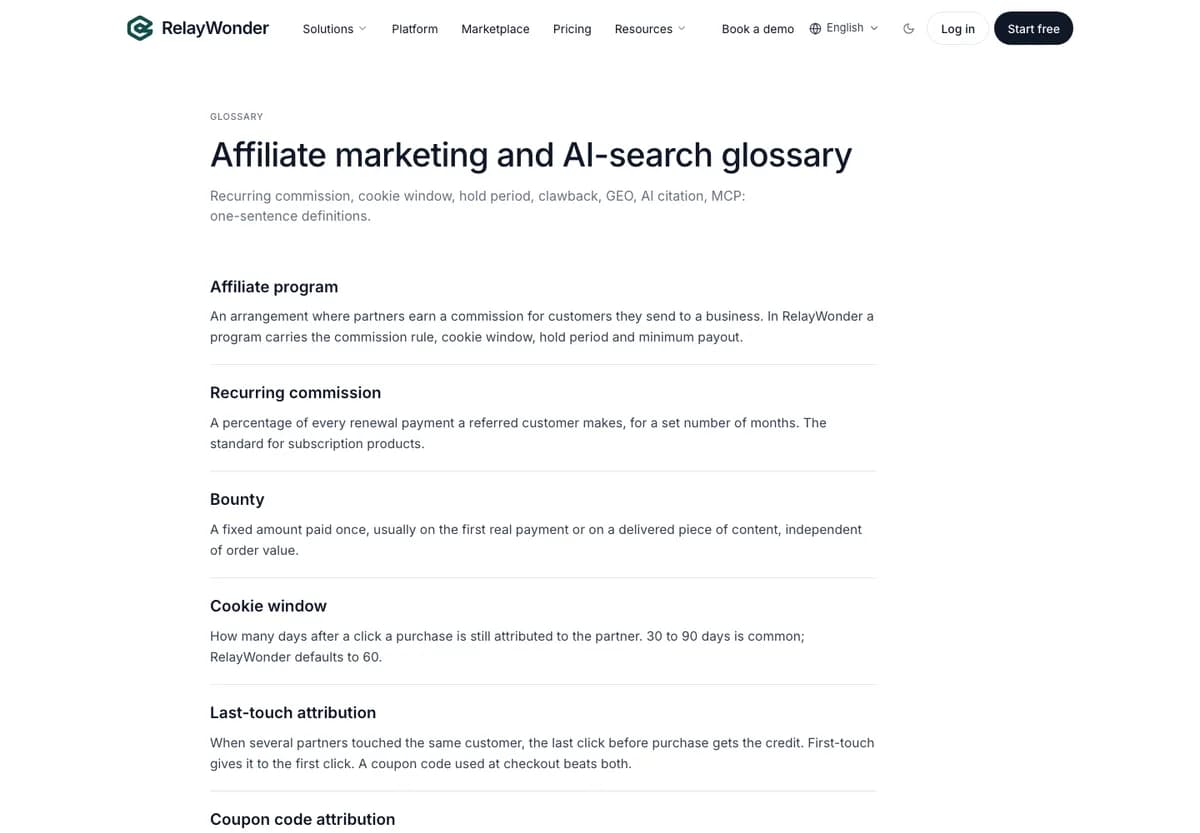
Five terms explain almost every affiliate arrangement a reader will meet, and RelayWonder's affiliate marketing glossary defines each of them in a sentence.
The cookie window is how many days after a click a purchase still counts for the publisher. RelayWonder notes that 30 to 90 days is common and uses 60 by default; Coursera uses 30. The practical consequence is that a recommendation read today can still earn a commission on a purchase made next month, which is why a site has no particular reason to push a reader to buy immediately.
Last touch attribution decides who gets credit when several publishers sent the same buyer. The last click before the purchase wins, and Coursera's program states the same rule. A coupon code used at checkout usually beats both, because it ties the sale to a specific partner without relying on a cookie at all.
The hold period is the time a commission stays pending before it can be paid. RelayWonder describes it as typically 30 days, long enough for refunds inside that window to reverse the commission first. A clawback is that reversal: when a payment is refunded or disputed, a negative record cancels the commission. This is the part of the system that most protects buyers, because it removes the incentive to recommend something people will regret.
The minimum payout is the balance a publisher has to reach before being paid, usually around 50 dollars. It matters little to readers and a great deal to small publishers, which is part of why so many small sites carry links that never pay out.
Why tracking sometimes fails
Affiliate tracking is less precise than it sounds, and the gaps run mostly in the reader's favour.
A purchase made on a different device from the one used to click will often not be attributed, because the identifier was stored on the first device. Clearing cookies, browsing privately or using a browser that limits how long tracking information is kept can all break the chain. Some ad blockers strip affiliate identifiers from links altogether. In each case the reader pays the same price and the publisher simply is not credited.
Publishers know this, and it explains a few habits that can look odd from the outside. Coupon codes exist partly because they survive device switches and cookie clearing. Recommendations are often repeated in several places on a page because a single link has a modest chance of being the last one clicked. Neither habit is sinister, though a page that is mostly links with little text around them is usually optimised for clicks rather than for readers.
For anyone who would rather not be tracked at all, the simplest option is to search for the seller directly instead of clicking the link. Nothing about the product changes.
Does a commission make a recommendation worse
This is the real question, and the honest answer is that it depends on whether the recommendation would exist without the money.
A commission creates an incentive to recommend things that pay well, recommend more things and recommend them more warmly. It does not automatically make a recommendation false. A reviewer who would have recommended the same course anyway, and who also earns a commission on it, has not been corrupted. A site that chooses what to recommend by commission rate, and writes enthusiastic copy around whatever pays most, has.
Research on disclosure suggests readers are right to want to know which situation they are in. In a 2017 experiment published in the Journal of Interactive Marketing, Sophie Boerman, Lotte Willemsen and Eva van der Aa showed people social media posts with and without the word Sponsored. When a celebrity posted, the disclosure helped people recognise the post as advertising, which in turn made them more distrustful of it and less willing to pass it on. A clear disclosure did its job: it changed how people weighed the message.
That finding cuts in favour of both readers and honest publishers. Readers get the information they need to adjust. Publishers who disclose clearly and recommend well lose little, because the adjustment readers make is to scrutinise, not to reject.
The signs that a paid recommendation is still a good one are mostly visible on the page. The recommendation is specific about who the product suits and who it does not. It mentions drawbacks. It sits next to free alternatives where those exist. And the same site recommends things it does not earn from, which is the strongest evidence that its recommendations are not chosen by commission.
Affiliate links and AI answers
A growing share of product research now happens inside chatbots, and this changes the affiliate picture in a way most readers have not noticed yet.
When an AI assistant answers a question about which course or tool to choose, it often draws on comparison articles and reviews, and many of those pages carry affiliate links. The chatbot's answer usually does not reproduce the link or the disclosure. The incentive that shaped the original page passes through into the summary, while the disclosure that let a reader weigh it is left behind.
That is not a reason to distrust every AI answer about products. It is a reason to open the sources an answer cites and check whether they disclose a commercial relationship, which takes a few seconds and restores the information the summary dropped. The companion piece on asking ChatGPT which personality test is most accurate describes the same check for questions about tests.
The incentives are also shifting at the source. Sellers now care whether they are named inside AI answers, not only whether they rank in search results, and some affiliate programs are beginning to pay publishers for content that AI engines go on to cite. RelayWonder's glossary includes entries for generative engine optimization and AI citation alongside cookie windows and clawbacks, which is a fair sign of where the industry thinks its next arguments will be.
What the law asks for
Disclosure is not only good manners. In several of the markets this site writes for, it is a legal requirement.
In the United States, the Federal Trade Commission's Endorsement Guides, last revised in 2023, require a publisher to disclose a material connection to a seller clearly and conspicuously. The FTC's own guidance makes three practical points. The disclosure should sit close to the recommendation, because readers who see the link without the disclosure may never make the connection. A disclosure buried on a separate page is not enough on its own. And the words matter: the FTC notes that some readers may not understand the phrase affiliate link, and suggests that wording such as paid link, or a sentence like I get commissions for purchases made through links in this post, is clearer.
In Japan, the Consumer Affairs Agency designated stealth marketing as a misleading representation under the Act against Unjustifiable Premiums and Misleading Representations, effective 1 October 2023. The rule targets content that ordinary consumers would find hard to recognise as a business's own advertising. Japanese pages that carry paid recommendations now commonly mark them with the word PR at the top.
Across the European Union, the Unfair Commercial Practices Directive bans editorial content that a trader has paid for when the payment is not made clear. Spain adds a detailed layer of self regulation. The advertising code of conduct for influencers promoted by AUTOCONTROL, the Spanish Advertisers Association and IAB Spain, in a version that took effect on 1 October 2025, counts affiliate links among the forms of payment that make content advertising, and requires the label to appear at the start of the message, plainly visible and not hidden behind a see more button.
How to read any recommended for you box
A short set of questions works on almost any recommendation, paid or not.
Is there a disclosure, and does it say who earns what? A clear sentence near the link is a good sign about the whole site, not just that link.
Is the recommendation tied to something specific? A course recommended because a test measured a particular interest is more trustworthy than a course recommended to everyone who reaches the page.
Does the page mention a free alternative? Many good things are free, and a site that only ever recommends paid products is telling the reader something about its priorities.
Are there drawbacks? A recommendation with no downside is copy, not judgement.
Would the reader have wanted this anyway? The most useful recommendations are the ones that save time on a decision already being made. The least useful create a need that was not there.
A worked example makes the questions concrete. Imagine a career test result that says someone's strongest interest is in analysing problems, followed by a box recommending a data analysis course. The disclosure sits right under the card and says the site earns a commission. The card says the course suits people who enjoy working through numbers and notes it assumes basic spreadsheet skills. Next to it is a free article on how interests relate to job choices.
That box passes most of the questions. It is tied to what the test measured, it names who the course does not suit, it sits next to something free and the money is disclosed where the reader will see it. What remains is the reader's own question: was a course already on the table? If not, the recommendation is still only a suggestion, and the free article is the better first step.
Change one detail and the picture changes. If the same course were recommended under every result, analytical or not, the recommendation would be tied to the page rather than to the person, and the personal feel of the result would be doing work the recommendation had not earned.
There is also a subtler trap specific to personality and career tests. A recommendation placed beside a result inherits the result's sense of being personal. The Barnum effect describes how people rate broad descriptions as highly accurate when they believe the descriptions were written for them, and a product placed under such a description can feel tailored when it is only categorised. The fix is to ask what, specifically, about the result makes this recommendation fit.
How MoodyWonder's own recommendations work
Since this site shows recommendations under its own results, it should be held to the same questions.
Each result page has one recommendation block with up to three cards. The first is usually something to read on this site. Another is either the next test in the same area or one of this site's own paid reports. A partner card, when there is one, replaces one of those slots: a course, a book or a tool from an outside seller, chosen for the specific test and sometimes for the specific result.
A partner card is labelled Partner pick and carries this sentence directly beneath it: Partner link, if you buy through it, MoodyWonder earns a small commission, and the price is the same for you. The Japanese version opens with the PR marker the Consumer Affairs Agency's rule expects. Partner links are marked as sponsored in the page's code, open in a new tab and are never routed through a MoodyWonder short link that hides where they lead.
Partner cards are chosen per test and, where it matters, per result, and they are chosen per language too. A course or book that is not available in a reader's market, or has no edition in their language, simply does not appear for that reader; the slot falls back to an article or another test rather than showing a link that would lead somewhere unusable. That rule costs commissions in practice, because many products are sold mainly in English, and it is kept because a recommendation a reader cannot use is worse than none.
Some choices are deliberate omissions. Wellbeing results do not carry partner cards for therapy or counselling services, even though those programs pay well, because a test result is not a diagnosis and a paid referral beside an anxiety score would imply one. Career results are where partner cards make the most sense, because the link between a measured interest and a relevant course is direct. On the Career Values test, for example, the partner slot is reserved for a tool for revising a résumé, intended for results that suggest a gap between what someone wants from work and what their current job provides.
The test of whether this is done well is the same one offered to readers above: whether the site also recommends things it earns nothing from. Most cards on this site are articles and other tests, which pay nothing, and the comparison of free personality tests recommends several tests run by other organisations.
When to ignore a recommendation entirely
Some situations call for skipping the box altogether, however clearly it is disclosed.
If the recommendation appears beside anything resembling a diagnosis, such as a result about anxiety, depression or attention, the right next step is a qualified professional, not a product. If the page creates urgency with countdowns or limited time pricing tied to a test result, the urgency is the product. If the recommendation promises that a course or a book will change a personality trait, it is promising more than personality research supports.
If the recommendation is a free trial that turns into a paid subscription, the cancellation terms matter more than the product description. Checking how to cancel, and setting a reminder a few days before the trial ends, takes a minute and removes most of the risk that a well meant recommendation turns into a charge nobody wanted. A recommendation that hides those terms has answered the question of whether to trust it.
And if the result itself felt wrong, nothing recommended because of it is likely to feel right. A result that does not fit is worth questioning before anything is bought on the strength of it.
Sources
- U.S. Federal Trade Commission. FTC's Endorsement Guides: what people are asking.
- Consumer Affairs Agency, Japan (2023). Stealth marketing becomes a violation of the Act against Unjustifiable Premiums and Misleading Representations from 1 October 2023.
- Boerman, S. C., Willemsen, L. M., Van Der Aa, E. P. (2017). "This post is sponsored": effects of sponsorship disclosure on persuasion knowledge and electronic word of mouth in the context of Facebook. Journal of Interactive Marketing, 38.
- Coursera. Affiliate program terms: commission range, cookie duration and attribution.
- European Union (2005). Directive 2005/29/EC on unfair business to consumer commercial practices, Annex I, point 11.
- Cuatrecasas (2025). Nuevo código de conducta de publicidad con influencers: contenido y claves prácticas.
- RelayWonder. How RelayWonder works.
- RelayWonder. Affiliate marketing and AI search glossary.