Type the question into ChatGPT and an answer arrives in a few seconds, confident and tidy. The Big Five is the most scientifically supported model, the Myers-Briggs is popular but less reliable, and here are a few free tests worth trying. It reads like the considered view of an expert. It is something else, and the difference matters for anyone deciding which result to take seriously.
An AI answer about personality tests is assembled. Part of it comes from what the model absorbed during training, part from pages it fetched for that particular question, and the selection of those pages is invisible from the outside. Which test gets named, which site gets linked and which caveat survives into the final paragraph are all decided in a layer most readers never see.
44%
of U.S. adults said in February 2026 that they use ChatGPT
8% vs 15%
Google visits ending in a click on a regular result, with an AI summary and without one
60%+
of test queries answered incorrectly by eight AI search tools
Those three numbers frame the problem. Asking a chatbot has become ordinary: Pew Research Center's February 2026 survey found 44 percent of American adults saying they use ChatGPT, against 18 percent in mid 2023. When an AI summary sits on top of a Google results page, people click through to an ordinary result about half as often. And when Columbia University's Tow Center for Digital Journalism tested eight AI search tools on a simple retrieval task, the tools were wrong more than six times in ten.
None of that means the answer about personality tests is wrong. It means nobody has checked it, including the person reading it, and the checking has quietly become the reader's job.
How an AI answer about personality tests gets built
There are two ways a chatbot can know something. The first is training. While a model is being built it reads an enormous amount of text and compresses the patterns in it. If thousands of articles written before its cutoff say the Big Five has stronger evidence than the Myers-Briggs, the model will reproduce that view, and it will usually be right, because on that point the expert consensus is real.
The second is retrieval, often called grounding. When search is switched on, the assistant sends the question, or a rewritten version of it, to a search index, pulls back a handful of pages and writes its answer from them. The links that appear under the answer are those pages. This is the part that changes from week to week, and it is the part that decides which specific tests and websites get named.
Most of the interesting distortions live in that second step. A page that states its claims plainly and early, in sentences a machine can lift out whole, is easier to quote than a careful essay that builds toward its conclusion. A site that blocks AI crawlers will never be fetched at all. A test publisher's own comparison page, which naturally rates its own test first, can be the most quotable page on the subject.
InsightWonder's glossary has a precise definition of grounding and of what counts as a citation inside an AI answer, for anyone who wants the vocabulary before going further.
How often AI search answers are right
The best public evidence comes from news rather than psychology, because news publishers have the strongest reason to test it. In March 2025 Klaudia Jaźwińska and Aisvarya Chandrasekar at the Tow Center gave eight AI search tools short excerpts from real articles and asked each tool to name the headline, the publisher, the date and the address. Every excerpt was chosen so that an ordinary Google search would surface the original among its top three results.
- Perplexity: 37%
- All eight tools: 60%
- Grok 3: 94%
Collectively the tools answered more than 60 percent of the queries incorrectly. Perplexity did best and was still wrong 37 percent of the time; Grok 3 was wrong on 94 percent. What struck the researchers was less the error rate than the tone. ChatGPT misidentified 134 of its 200 articles and signalled any lack of confidence only 15 times, and it never declined to answer. More than half of the responses from Gemini and Grok 3 cited addresses that were invented or broken.
A question about personality tests is easier than matching a news excerpt to its source, so the error rate on it is probably lower. The pattern that matters still carries over. A confident sentence with a link under it does not mean the link says what the sentence says. InsightWonder keeps a plain definition of hallucination in exactly this sense, and it is worth reading once.
Why some tests and sites get named and others do not
If the answer depends on which pages were retrieved and how easily they could be quoted, then pages can be written to be retrieved and quoted. This is now a field with a name, generative engine optimization, usually shortened to GEO, and a research literature behind it.
The paper that gave the field its name came from researchers at Princeton, Georgia Tech, the Allen Institute for AI and IIT Delhi and was presented at KDD 2024. Its central result was that changes to how a page is written, such as adding statistics, quotations and citations, could raise that page's visibility inside generative answers by up to 40 percent. The changes did not alter what was true. They altered how quotable the truth was.
That finding cuts two ways for someone asking which personality test to trust. It is reassuring that careful, sourced writing tends to be favoured. It is less reassuring that the same techniques are open to anyone, including a test publisher with a commercial reason to be named first.
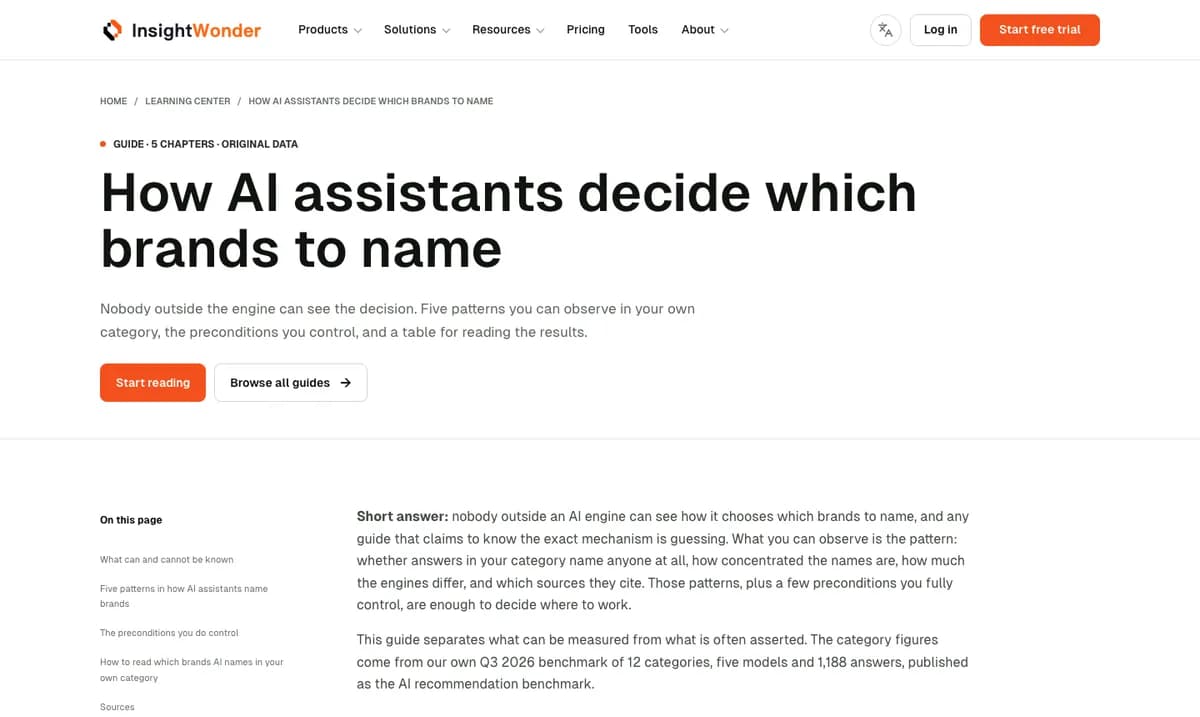
InsightWonder's guide on how AI assistants decide which brands to name opens with an admission most writing on this subject avoids: nobody outside an engine can see the decision. What can be observed is the pattern across many answers, which names recur, how concentrated they are and which sources get cited. That is the honest frame for any single answer, including the one about personality tests. It is one draw from a distribution, not a verdict.
Where the sources behind these answers come from
When the links under an AI answer about personality tests are opened, they tend to fall into four kinds, and each kind leans in its own direction.
The first is the test publisher. A site that sells or hosts a personality test has every reason to explain why its model is the right one, and these pages are often the clearest and most quotable on the subject, because they were written to persuade. They are not wrong by default. They are an interested party, and a ranking built mostly from them inherits that interest.
The second is the general reference page, an encyclopedia entry or a broad explainer. These are usually balanced and usually a few years behind. A reference page may describe a test version that has since been replaced, or summarise a debate that has moved on.
The third is the discussion forum. Threads where people compare their results are vivid and honest about experience, and they are a poor guide to measurement. A forum can tell a reader that a test felt accurate to many people; it cannot tell whether it is.
The fourth is the research source, a journal article or a university page, and it is the least common in casual answers because it is the hardest to quote. Its findings arrive hedged, buried in methods and stated in effect sizes rather than verdicts. An answer that cites at least one source of this fourth kind deserves noticeably more trust than one that cites none.
InsightWonder's guide to citation analysis describes how to read the sources behind an answer systematically, and most of it applies outside marketing. The short version is to ask, for each link, who wrote it and what they gain if it is believed.
What accurate should mean for a personality test
Before judging whether an AI answer is right, it helps to know what right would look like. Accuracy in a personality test is not one property. Psychologists split it into at least three.
Reliability is whether the test gives the same result twice. A questionnaire that sorts the same person into different categories a few weeks apart is measuring something unstable, or measuring it badly. Validity is whether the scores track what they claim to track, which is the harder question and the subject of the entry on construct validity. Usefulness is whether the result predicts anything that happens outside the test, such as grades, health, relationships or how a job turns out.
On the third count the evidence for the Big Five is unusually strong. In 2019 Christopher Soto ran preregistered replications of 78 published links between Big Five traits and life outcomes, with a median sample of 1,504 people per replication. 87 percent of the attempts were statistically significant in the expected direction, although the effects were typically about three quarters the size of the originals. For a field that lived through a replication crisis, that is a good record.
This is roughly what a good AI answer will say, and on this question the consensus it reflects is genuine. The Big Five overview explains the five traits in more depth, and the Big Five test reports where a person sits on each one as a percentile rather than a type. The Myers-Briggs style test is worth taking with that comparison in mind: it is a good conversation starter and a weaker measurement.
What an AI answer is much less likely to get right is the next step down, which particular free test online measures the Big Five well. That depends on details a chatbot rarely sees: how many items the test uses, whether it reports percentiles against a stated reference sample, and whether the free result is the whole result. The comparison of free personality tests on this site goes through those details one test at a time, and it lists this site's own test with its weaknesses.
What AI answers usually get right, and what they wave through
On the headline comparison, trait measures against type models, AI answers tend to be sound, because the published literature is lopsided and the models have absorbed it. They are less reliable on the frameworks that sit between serious measurement and entertainment, and that middle ground is where most readers actually spend their time.
The Enneagram is the clearest example. It is a rich vocabulary for motivation and it has a large, devoted literature of its own, but its evidence as a measurement is thin compared with the Big Five, and its categories have not been shown to carve people at natural joints. Some AI answers say so plainly. Others describe the nine types with the same confidence they would give a validated trait, because the most quotable pages about the Enneagram are written by its practitioners. The overview of the Enneagram types on this site keeps that limitation in view, and the entry comparing type frameworks explains where each family of models stands.
Astrology is the opposite case, and AI answers generally handle it well. When the physicist Shawn Carlson ran a double blind test published in Nature in 1985, astrologers could not match birth charts to personality profiles better than chance, which is about as clean a result as personality research produces. A chatbot that recommends a horoscope as a personality test has failed a question with an unusually clear answer.
The pattern is worth remembering. Where the evidence is overwhelming in either direction, AI answers tend to follow it. Where the evidence is mixed and the most enthusiastic writing comes from practitioners, AI answers tend to follow the enthusiasm.
A way to check the answer in five minutes
Checking an AI answer takes about five minutes and no expertise in psychology. It does require opening the links rather than reading the summary.
| What the answer says | What to check | What a good sign looks like |
|---|---|---|
| The Big Five is the most scientific model | Whether the cited source is a journal, a university or a test vendor | At least one source that is not selling a test |
| Test X is the most accurate free test | How many questions it has and whether it reports percentiles | 40 or more items and percentiles against a named sample |
| The Myers-Briggs is unreliable | Whether the source explains why or only asserts it | A specific reason, such as letters flipping near the midpoint |
| Here are three free tests | Whether one listed site is also the main source of the answer | The ranking is not just one vendor's own list repeated |
| Your type means you should | Whether a result is being stretched into a prescription | A caution about using tests for hiring or diagnosis |
Two habits make most of the difference. The first is to ask the same question in a second engine, or twice in the same one, and compare. Answers built from retrieval vary, and a test that is named every time is a stronger signal than one named once. The second is to ask the assistant directly which sources it used and why. A good assistant will list them; a vague reply is itself information.
One more check is easy to forget: the date. Personality tests get revised, free versions get shortened, and a page describing a test as it was five years ago can still be the one a chatbot retrieves. Looking for a date on each cited page takes seconds, and InsightWonder's guide to content freshness and dates explains which date signals a machine can actually see, which is not always the date a human reader notices first.
For anyone who would rather see the hidden step than infer it, InsightWonder's free AI Visibility Snapshot asks a real AI engine a small set of questions about a website and shows which names come up and which pages get cited. It needs no account. The tool is candid that each run is a one time sample of five questions on one model rather than a measurement of a market, which is exactly how any single chatbot answer ought to be read.
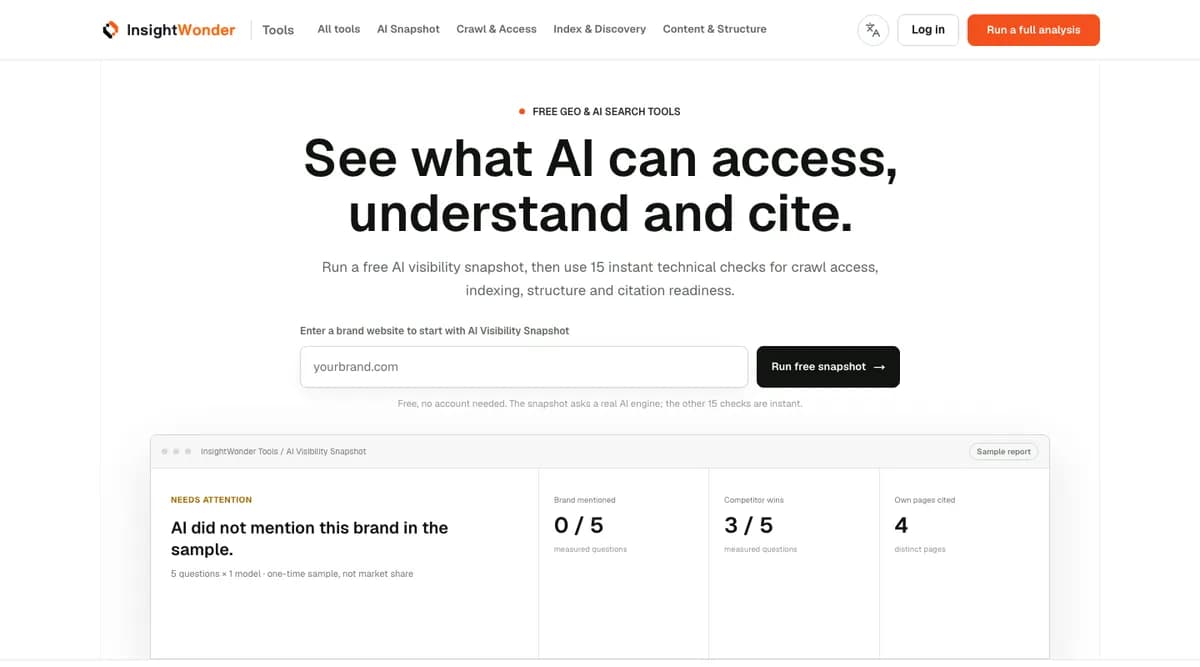
Running it on a few personality test websites is instructive. The same handful of domains tends to be cited again and again, and they are not always the ones with the strongest evidence. They are the ones whose pages are easiest to quote.
Asking an AI to interpret a result you already have
A growing share of people do the opposite of asking which test to take. They take a test, paste the result into a chatbot and ask what it means. This is a more reasonable use of the tool, and it has its own failure mode.
The reasonable part is that a language model is good at explaining definitions. Ask what high conscientiousness and low agreeableness tend to look like together at work, and the answer will usually be sensible, because the research on trait combinations is large and well represented in training data. The explanation of a single trait is where a chatbot is closest to a decent textbook.
The failure mode is generosity. Chatbots are tuned to be agreeable, and an interpretation written for one particular reader tends toward the flattering and the broadly true. That is the shape of the Barnum effect: people rate vague descriptions that could fit almost anyone as remarkably accurate when they believe the description was written for them. A test result interpreted warmly by a chatbot can feel more precise than either the test or the chatbot actually is.
There is a simple correction. Ask the same assistant to describe what the opposite score would look like, and to say which parts of its interpretation would apply to most people. The parts that survive that question are the parts worth keeping.
The same caution applies to the assistant on this site. Luna reads the results someone has taken here, which makes its answers more specific than a general chatbot's, and it is still a language model writing an interpretation rather than a measurement.
Why the answer sounds more certain than the evidence
Part of what makes AI answers persuasive is that they borrow the register of expertise without its hedges. A psychologist asked which personality test is most accurate will usually answer with a question: accurate for what? For a team building afternoon, a type model is fine. For research, or for anything with consequences, a validated trait measure is the defensible choice, and even then a single sitting is a snapshot.
The chatbot tends to compress all of that into a ranking. The ranking is not wrong so much as it answers a simpler question than the one that was asked. And a ranking flatters the reader in a particular way. It suggests that once the right test has been found, the result can be taken at face value.
Every personality test, the good ones included, asks people to describe themselves. The entry on self report questionnaires covers what that builds in: the way people see themselves, which is close to the truth for some traits and further from it for others. No ranking of tests removes that limit. It only tells a reader which instruments handle it best.
What this changes about the next answer
The practical upshot is modest and useful. An AI answer is a reasonable place to start a question about personality tests and a poor place to finish it. On the broad question of trait measures against type models it will usually reflect a real consensus. On the specific question of which free test to take and how far to trust it, it reflects whichever pages it happened to retrieve that day.
The sources behind the answer are the part worth looking at. They are also, increasingly, the part being shaped, by researchers studying the effect and by businesses trying to be named. Knowing that is enough to read the next answer differently.
A test result deserves the same treatment. The entry on free tests and formal assessments sets out what a free online questionnaire can and cannot tell anyone, and it applies to every test on this site as much as to any other.
Sources
- Pew Research Center (2026). Americans and AI 2026: chatbots, smart devices and views on impact.
- Pew Research Center (2025). 34% of U.S. adults have used ChatGPT, about double the share in 2023.
- Pew Research Center (2025). Google users are less likely to click on links when an AI summary appears in the results.
- Jaźwińska, K., Chandrasekar, A. (2025). AI search has a citation problem. Columbia Journalism Review, Tow Center for Digital Journalism.
- Aggarwal, P., Murahari, V., Rajpurohit, T., Kalyan, A., Narasimhan, K., Deshpande, A. (2024). GEO: generative engine optimization. Proceedings of KDD 2024.
- Soto, C. J. (2019). How replicable are links between personality traits and consequential life outcomes? The Life Outcomes of Personality Replication Project. Psychological Science, 30(5).
- Carlson, S. (1985). A double-blind test of astrology. Nature, 318.