The pitch is familiar. Recommend products you already use, add a link, and earn a commission every time someone buys. Some creators do build a living this way. Most do not, and the gap between the pitch and the typical outcome is wide enough that anyone considering it deserves the numbers first.
This piece is a reality check rather than a warning. Affiliate income is real, it can be honest and it suits some people well. The useful questions are how it actually adds up, who tends to make it work and how to find out cheaply whether that person is you.
12%
of full-time creators in Linktree's 2022 survey earned over $50,000 a year
46%
of full-time creators in the same survey earned under $1,000 a year
68%
of part-time creators earned under $1,000 a year
What the income data actually shows
The best known survey of creator income is Linktree's 2022 creator report, drawn from about 9,500 creators. Among people who described themselves as full-time creators, only 12 percent earned more than 50,000 dollars a year, while 46 percent earned less than 1,000. Among part-time creators, 68 percent earned under 1,000 dollars.
- Over 50000 dollars: 12%
- Under 1000 dollars: 46%
The shape matters more than any single figure. Creator income is extremely lopsided: a small group earns a great deal and the large majority earns very little, which is the pattern of most markets where attention is the currency. The same survey found that 70 percent of creators earned less than a tenth of their income from brand partnerships, which suggests that even the sponsorships people imagine as the main prize are a minor source for most.
The size of the field is harder to pin down than it sounds. Goldman Sachs Research estimated about 50 million creators worldwide in 2023 and projected that the creator economy could grow from roughly 250 billion dollars to around 480 billion by 2027. Linktree, using a broader definition, suggested over 200 million people could be classified as creators. Neither number is wrong. They count different things, and the gap is a useful reminder that statistics about this industry are soft.
How affiliate income actually adds up
Affiliate income is arithmetic, and doing the arithmetic early prevents most disappointment.
A commission is a percentage of a sale, or a fixed bounty per customer. A course that costs 50 dollars, at a 20 percent commission, pays 10 dollars a sale. One sale a week from that single recommendation comes to about 520 dollars a year before any fees or tax. To turn that into a living requires either many recommendations producing sales at the same time, or products with much larger commissions, or both.
The commission rate also varies more than people expect. Coursera's program, for example, publishes a range of 15 to 45 percent depending on what is bought, and pays only on the first month of monthly subscriptions. Other programs pay recurring commissions for as long as the customer stays subscribed, which rewards recommending things people keep using. The structure of the commission shapes what is worth recommending at all.
Then come the delays. Commissions sit in a hold period, typically around 30 days, so refunds can reverse them before they are paid. Many programs only pay once a balance passes a minimum, often around 50 dollars. A creator who makes a first sale today may not see that money for six weeks or more. The companion piece on how affiliate links work explains cookie windows, attribution and clawbacks in detail, and they matter here because each one shapes how quickly income becomes real.
Which products make affiliate income workable
Not every product is worth recommending as a source of income, even when it is worth recommending to an audience.
Cheap impulse purchases pay little per sale and need enormous volume to add up. They suit creators with very large audiences and are a poor foundation for anyone starting out. Products people consider carefully, such as courses, software and equipment that lasts for years, pay more per sale and tend to be bought after reading or watching something detailed, which is exactly the kind of content a smaller creator can make well.
Subscriptions deserve a second look because of how they pay. A program with a recurring commission keeps paying as long as the customer stays, so one honest recommendation of a tool people genuinely keep using can be worth more over a year than many one off sales. The catch is that recurring income rewards products with low cancellation, which a creator cannot control and should not oversell.
The most reliable pattern is unglamorous. A creator recommends a small number of things they actually use, in content that answers a specific question, and updates that content when the products change. A handful of pieces like that, kept current, usually outperform a large number of thin roundups.
What a realistic first year tends to look like
There is no reliable data on how a typical creator's affiliate income grows month by month, and anyone quoting a precise curve is guessing. The shape described by people who have done it is consistent enough to be useful, though.
The first few months are mostly building. Content goes out, an audience slowly forms and the affiliate links earn little or nothing, partly because there are few readers and partly because hold periods delay whatever does sell. This is the stage where most people stop, usually because the effort feels disconnected from any result.
Somewhere after that, the first commissions arrive, small and irregular. They are more valuable as information than as money: they show which pieces of content lead people to act and which do not. Creators who pay attention at this stage tend to improve and update the pieces that work rather than producing more of everything.
By the end of a first year, a pattern usually exists. A few pieces of content produce most of the income, the audience has a sense of what the creator recommends and why, and it is possible to judge honestly whether the work is heading somewhere worth continuing. That judgement, rather than the income itself, is what the first year is for.
Why most creators earn little
The common explanations are audience size and luck, and both play a part. Three other causes are more within a creator's control.
The first is fit. A recommendation works when it answers a question the audience already has. A creator who reviews hiking gear and recommends a hiking course is useful; the same creator recommending a cryptocurrency platform because it pays well is noise, and audiences notice.
The second is trust, which is slow to build and fast to lose. An audience that has seen a creator say no to products, or point out a drawback, believes the yes. An audience that has only ever heard yes stops listening.
The third is patience. Affiliate income tends to come from content that keeps being found long after it was made: a thorough comparison, an honest review, a guide that answers a specific question. That kind of content accumulates value over months and years, and most people stop before it has had time to.
Personality and the creator business
Being a creator who earns from recommendations is a form of self employment, and there is a solid research base on which personality traits are associated with working for oneself.
In 2006 Hao Zhao and Scott Seibert combined earlier studies of entrepreneurs and managers into a meta-analysis organised around the Big Five. Entrepreneurs scored higher on conscientiousness and openness to experience, and lower on neuroticism and agreeableness. Extraversion, which most people assume would matter most, did not separate the groups in the same way.
Applying that to creators is an analogy rather than a direct finding, because the studies concerned founders and business owners. The analogy is still instructive, and each trait maps onto a recognisable part of the work.
The fourth row deserves a note. Low agreeableness has a bad reputation, but in this context it often shows up as the ability to turn down money for the sake of an audience's trust. Creators who find it painful to refuse a brand tend to end up recommending things they would not choose, and their audience pays the cost first.
The Big Five test reports where someone sits on all five traits as percentiles, and the Big Five overview explains what each trait means in practice. A profile is not a verdict, but it is a fair way to anticipate which parts of the work will feel natural and which will need deliberate effort.
Interests matter as well as traits. Creator work blends making something with persuading people to act, which in Holland's terms is a mix of Artistic and Enterprising interests. The Career Interest Match test scores all six interest types, and someone strongly Artistic with little Enterprising interest may love making content and dislike the selling that affiliate income requires. The Leadership Potential test adds another angle, since running a one person media business means directing work that nobody else will check.
Choosing a channel to match a temperament
Creator work is often imagined as video, which puts off people who would rather not be on camera. The channel is a choice, and it is worth making to fit a personality rather than a trend.
Video rewards presence and energy, and suits people who enjoy performing and are comfortable being recognised. Writing, whether on a website or in a newsletter, rewards depth and patience, and suits people who think best on the page. Podcasts sit between the two: conversational, but without the visual pressure. Communities reward responsiveness and suit people who like many small exchanges more than a few large pieces.
Two practical differences matter for affiliate income specifically. Written guides and reviews tend to keep being found through search for years, so they accumulate value in a way a short video often does not. And written content is increasingly what AI assistants draw on when people ask them for recommendations, which the piece on asking ChatGPT which personality test is most accurate describes from the reader's side. A creator who prefers writing is not choosing the smaller channel. In some ways it is the more durable one.
The extraversion point from the trait research applies here. Someone low in extraversion can build a solid recommendation business entirely in writing, and many do. Forcing a reserved temperament into daily video is a common reason people give up early.
Recommending things without losing the audience
The fastest way to destroy a creator business is to recommend badly, and the second fastest is to recommend without saying so.
Disclosure is a legal requirement in the main markets. In the United States the Federal Trade Commission expects a clear statement near the link that the creator earns from purchases. In Japan, undisclosed paid promotion has counted as a misleading representation since October 2023, which is why Japanese creators mark paid content as PR. In Spain, the advertising code of conduct for influencers counts affiliate links among the forms of payment that make content advertising, and requires the label at the start of the message.
Beyond the law, the practical rule is simple. Recommend only what would be recommended anyway, say who it does not suit and keep making content that earns nothing. That last part is what makes the paid recommendations credible.
The money questions nobody mentions at the start
A few practical matters catch most new creators off guard, and they are easier to handle before the first sale than after.
Currency is one. Many affiliate programs pay in U.S. dollars, and the route from a dollar balance to a local bank account can involve conversion fees, transfer fees or a payment service that takes its own share. Comparing the options once, early, saves a small but permanent leak.
Records are another. Commissions arrive in batches, sometimes weeks after the sale, often net of reversals. A simple monthly record of what was earned, what was reversed and what actually arrived makes every later decision easier, from deciding which content to update to answering a question from a tax adviser.
Contracts are the third. Brand deals and some affiliate programs include clauses about exclusivity, about how the product may be described or about content that must stay published for a set period. Reading those clauses before agreeing is ordinary professional practice, and a brand that resists being asked about them has answered a question about itself.
None of this is difficult. It is simply the part of self employment that the passive income pitch leaves out, and the part that decides whether a small income stays small or becomes manageable.
Where creators find programs
There are three broad routes into affiliate programs, and most creators end up using more than one.
| Route | How joining works | What it suits |
|---|---|---|
| A seller's own program | Apply directly on the seller's website | Creators already recommending one product often |
| A large network | One account, then apply to each brand inside it | Creators who recommend products from many sellers |
| A smaller specialist network | Join once, then apply to campaigns as they open | Creators in a niche the network serves well |
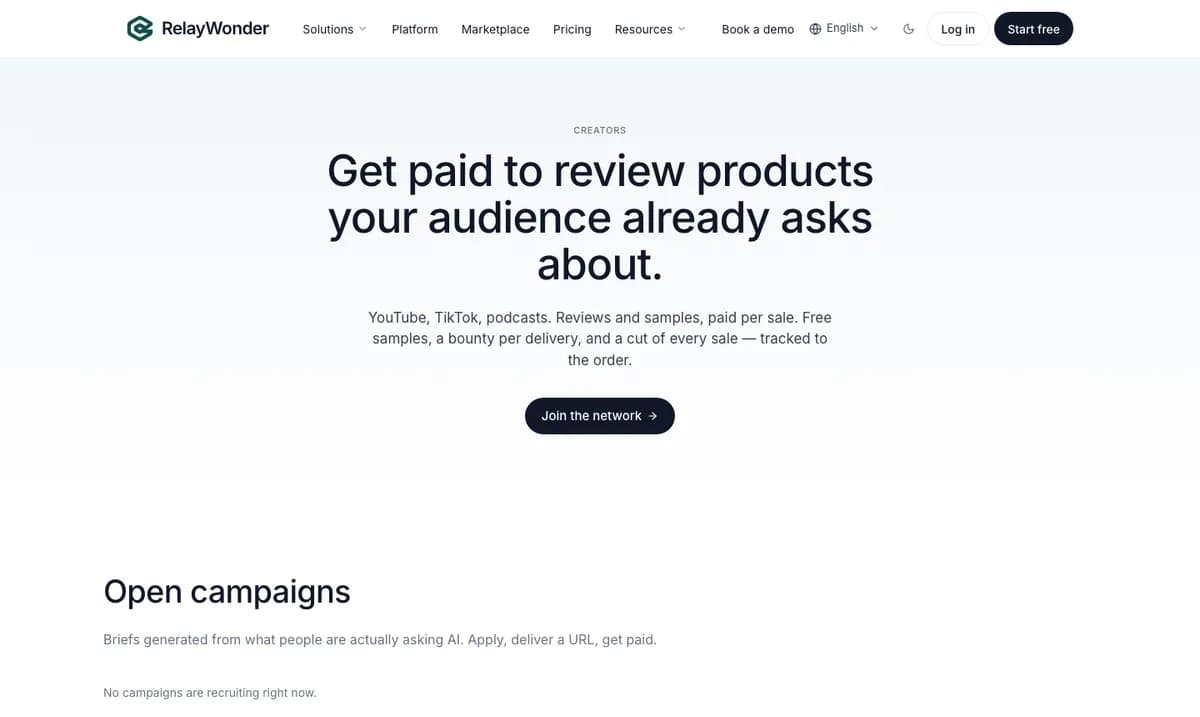
RelayWonder's page for creators describes paid product reviews: free samples, a bounty for each delivered piece and a share of every sale, tracked to the order. Joining is free for partners, and its page for publishers covers websites and newsletters. Two limits should be clear before anyone signs up. At the time of writing its brands are software companies that take payment through Stripe, with Shopify stores listed as coming soon, so the range of products is narrow. And its creator page currently says no campaigns are recruiting, which means a new creator would be joining a waiting list rather than a market.
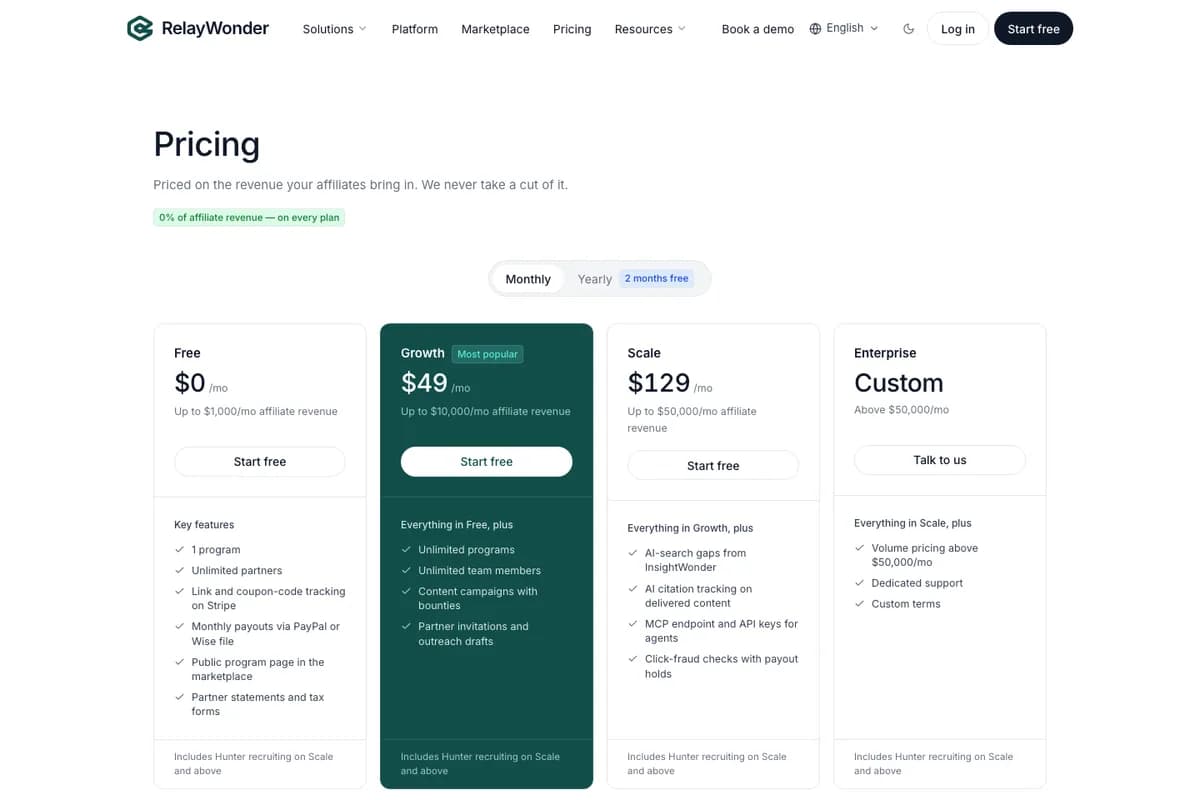
What it does differently is transparency about the money. Brands on the network pay nothing on their affiliate revenue, and its pricing page is public. Commission records are kept in a ledger that is added to rather than edited, so refunds appear as separate reversing entries, and partners are paid directly by the brand rather than through the platform. For a creator, those details answer the question that most often sours affiliate relationships: whether the numbers on the dashboard can be trusted.
The larger networks remain the practical starting point for most creators because they carry far more brands. A smaller network is worth joining when its niche matches the creator's audience closely, not as a substitute for the large ones.
The impostor feeling when recommending things
Many new creators describe the same discomfort when they start recommending products: a sense that they are not expert enough to tell anyone what to buy, and that someone will eventually notice.
That feeling has a name, the impostor phenomenon, and it is common among capable people moving into unfamiliar roles. In creator work it has a useful side. A creator who worries about being found out tends to check claims, mention limitations and avoid overselling, which are exactly the habits that build an audience's trust. The problem arises only when the feeling stops someone from publishing at all.
The Imposter Syndrome test on this site measures how strongly that pattern shows up. A high score is not a reason to avoid creator work. It is a prompt to set a publishing routine that does not depend on feeling ready.
When affiliate income is the wrong goal
For some creators, chasing commissions is the wrong strategy even when they have a loyal audience.
A creator with deep expertise in one subject often earns more, and more reliably, by selling something of their own: a course, a template, a consulting hour. Affiliate income pays a share of someone else's product; a creator's own product keeps the whole price and builds a direct relationship with the buyer. The trade off is more work and more risk.
A creator whose audience comes for entertainment rather than advice may find recommendations feel out of place to that audience, and income from sponsorship or from the platform itself may suit the content better.
And someone who needs reliable income now is usually better served by employment or freelance work in the same field, with recommendations as a side project that grows slowly. There is no shame in that route. Many creators who now earn well from recommendations built them in evenings, on top of a job that paid the bills.
How to test the fit before building a business on it
The cheapest experiment is a small one with a fixed end date. Pick one narrow topic where an audience already asks for recommendations, publish a handful of genuinely useful pieces over two or three months, add affiliate links only where they help and disclose them clearly.
At the end the useful questions are mostly not about money, since a few months is too short for income to mean much. Did the publishing schedule hold without constant effort? Was turning down an unsuitable product easy or agonising? Did the work of persuading feel natural, or did it feel like a betrayal of the making? Those answers say more about whether the path suits someone than any income figure.
The entry on work and identity is about why fit matters beyond money. Self employment can be deeply satisfying for people whose traits and interests suit it, and quietly exhausting for people who chose it for the promise rather than the work.
Sources
- TechCrunch (2022). Only 12% of full-time creators make over $50K a year, says Linktree.
- Goldman Sachs Research (2023). The creator economy could approach half a trillion dollars by 2027.
- Zhao, H., Seibert, S. E. (2006). The big five personality dimensions and entrepreneurial status: a meta-analytical review. Journal of Applied Psychology, 91(2).
- Coursera. Affiliate program terms: commission range, cookie duration and attribution.
- U.S. Federal Trade Commission. FTC's Endorsement Guides: what people are asking.
- Consumer Affairs Agency, Japan (2023). Stealth marketing becomes a violation of the Act against Unjustifiable Premiums and Misleading Representations from 1 October 2023.
- RelayWonder. For creators.
- RelayWonder. Pricing.