Summary
Overthinking is not a character weakness. Research shows that chronic ruminators activate the default mode network at significantly higher baseline rates than non-ruminators, a pattern measurable through validated psychometric tools (Nolen-Hoeksema, Wisco & Lyubomirsky, 2008). Yet most people who overthink are handed a label and told to "think less," which does nothing to address the underlying cognitive mechanism. This guide examines the neuroscience and psychology of overthinking as a measurable pattern, explains what separates rumination from productive reflection, and introduces MoodyWonder's approach to assessing Behavioral Default: the automatic cognitive response pattern a person reverts to under stress or ambiguity, regardless of their stated intentions. The MoodyWonder Overthinking Test is designed to map that pattern, not name it.
The Problem With Calling It a Flaw
1.1 What the Research Actually Says Before You Call It a Problem
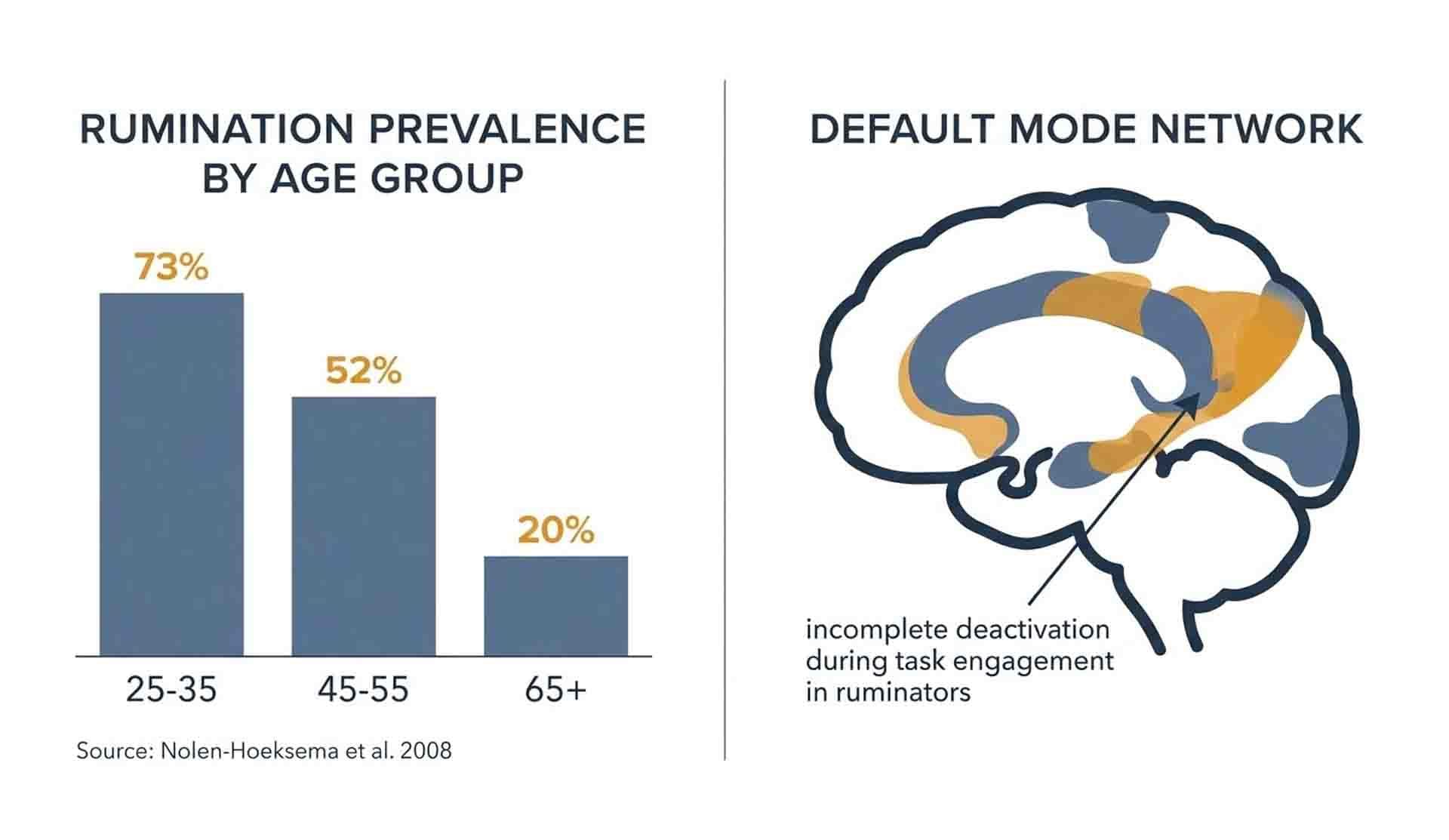
Approximately 73% of adults aged 25 to 35 identify as chronic overthinkers, according to a study by Nolen-Hoeksema and colleagues (2008) that surveyed over 1,300 participants across age groups. That number drops to 52% in the 45-to-55 age bracket, and to 20% among adults over 65. The pattern is not random. It does not mean that younger adults are more neurotic or less capable of mental discipline. It means something specific is happening cognitively, and it changes over time.
That single data point should reframe the entire conversation. When the majority of a demographic shares a cognitive tendency, the word "flaw" stops making clinical sense. You do not call myopia a character defect. You measure it, understand it, and work with it.
The problem is that most people who identify as overthinkers have been given a label rather than a map. They have been told they "think too much," advised to "just let it go," or handed a breathing exercise that addresses the symptom while leaving the pattern completely intact.
1.2 Why This Matters More in 2026 Than It Did a Decade Ago
The cognitive load placed on knowledge workers has increased substantially over the past decade. A 2023 report by the American Psychological Association found that 77% of workers reported experiencing work-related stress, with cognitive overload cited as a primary driver in professional environments that demand rapid context-switching, asynchronous communication, and constant ambient notification.
In that environment, a person whose Behavioral Default under ambiguity is to continue processing rather than act is not exhibiting weakness. They are exhibiting a pattern that was adaptive in lower-stakes, slower-paced contexts, and is now being triggered at a frequency and intensity the original cognitive architecture was not calibrated for.
That is a measurable problem. And measurable problems have measurable responses.
Consider a senior UX researcher who spends four hours drafting and deleting a single email to a stakeholder. She is not anxious in general. She is not low in confidence. She is operating from a Behavioral Default that requires more data before it permits action, deployed in a context that provides no additional data no matter how long she waits. The loop has no natural exit. Understanding that distinction is where any useful intervention has to begin.

Rumination vs. Reflection: The Distinction That Changes Everything
2.1 Defining the Terms With Precision
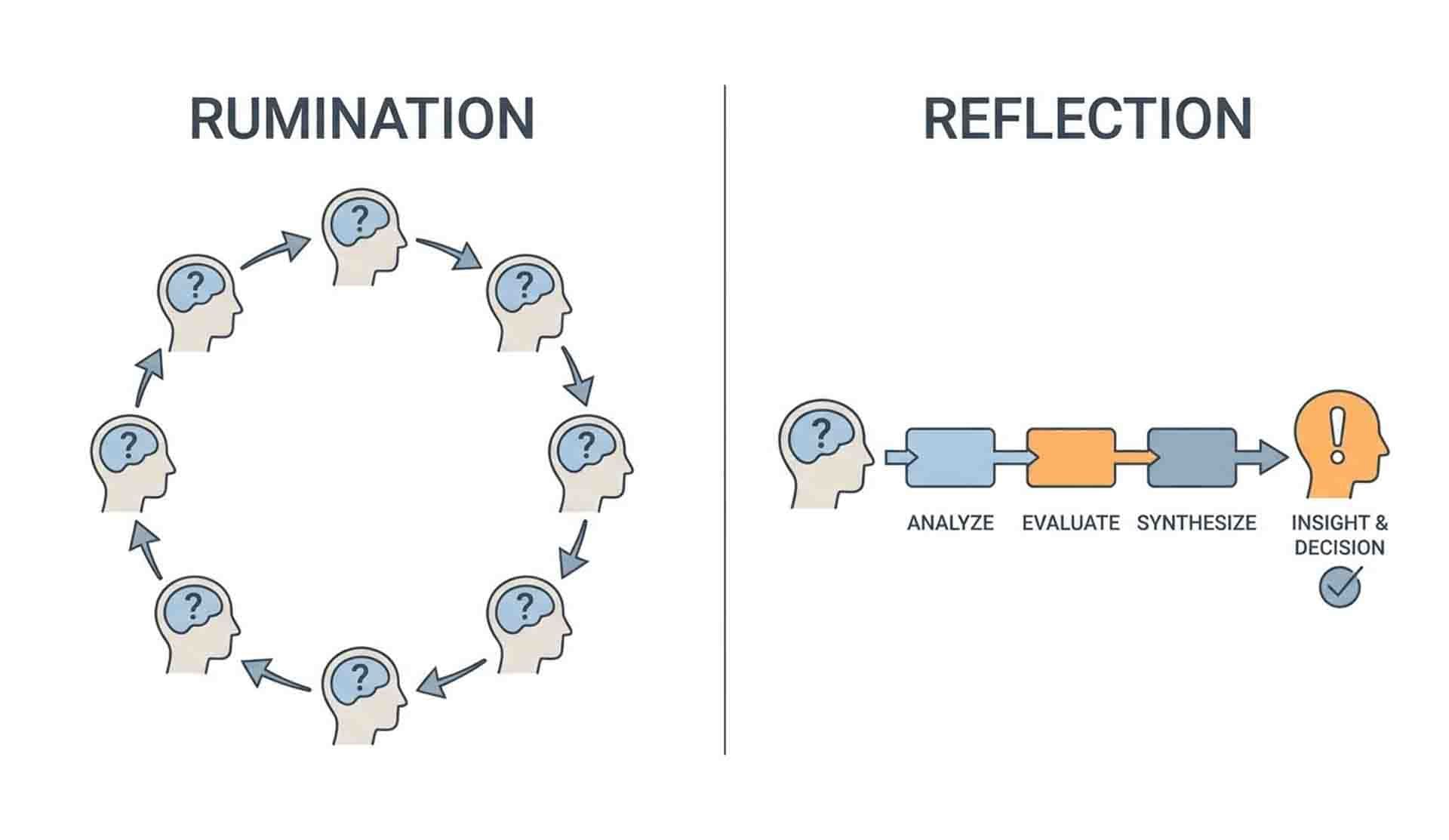
Rumination is repetitive, passive focus on the causes and consequences of distress without movement toward resolution. Reflection is deliberate, structured cognitive processing directed toward understanding and action.
They feel similar from the inside. Both involve sustained mental engagement with a problem. Both can last for hours. The difference is not duration or intensity. It is directionality.
Rumination circles. Reflection moves. A person reflecting on a difficult conversation is extracting information: what was said, what was meant, what they want to do differently. A person ruminating on the same conversation is replaying it, feeling the same discomfort each time, and generating no new information with each cycle. The content is identical. The cognitive function is entirely different.
This distinction matters because nearly every popular framework for addressing overthinking treats rumination and reflection as the same thing and tells you to do less of both. That is a significant error. Eliminating reflection is not a mental health goal. Interrupting rumination loops is.
2.2 The Research That Separates These Two Processes
Susan Nolen-Hoeksema's response styles theory, first published in 1991 and refined over two decades of follow-up research, established that rumination, specifically the tendency to passively focus on symptoms of distress and their potential causes and consequences, predicts the onset, duration, and severity of depressive episodes more reliably than the initial stressor itself (Nolen-Hoeksema, 1991).
A 2010 meta-analysis by Mor and Winquist, analyzing 141 studies, found that self-focused attention correlates with negative affect at r = 0.43, a moderate-to-strong effect size, but that this relationship was significantly moderated by whether the self-focus was ruminative or reflective in nature. Reflective self-focus showed weak or no negative correlation with emotional outcome measures. The type of cognitive engagement, not the quantity, was the operative variable.
This finding is widely cited in clinical literature and routinely ignored in wellness content. Most "stop overthinking" articles are, in effect, telling people to stop reflecting, which is neither achievable nor desirable. The clinically supported target is the ruminative pattern specifically.
2.3 How Most Tools Miss This Entirely
Standard anxiety and stress assessments do not distinguish between ruminative and reflective cognition. The GAD-7, for instance, measures generalized anxiety symptom frequency but does not profile the cognitive style underneath those symptoms. A person who scores high on GAD-7 items related to "worrying too much" might be a chronic ruminator, a high-reflector under acute stress, or someone experiencing an entirely situational response to a temporary crisis. The instrument cannot tell you which one.
This is where MoodyWonder's approach diverges from standard anxiety screening. The MoodyWonder Overthinking Test is not a symptom checklist. It is designed to identify the cognitive pattern structure underneath the symptoms: specifically, whether a person's sustained mental processing is ruminative or reflective in character, and what environmental conditions trigger the shift from one to the other.
That design decision is not cosmetic. It changes what the results can tell you.
The Neuroscience and Psychology Behind Overthinking
3.1 The Default Mode Network and Why It Matters
The neurological basis of overthinking is better understood now than at any previous point in clinical research. The default mode network (DMN), a set of interconnected brain regions including the medial prefrontal cortex, posterior cingulate cortex, and angular gyrus, activates during internally directed thought: self-referential processing, mental time travel, and social cognition (Buckner, Andrews-Hanna & Schacter, 2008).
In neurotypical individuals, the DMN deactivates when attention shifts to an external task. In individuals with high ruminative tendency, this deactivation is incomplete or delayed. The network continues running in the background during task engagement, producing the subjective experience of intrusive thoughts, difficulty concentrating, and mental fatigue even after a task is technically complete.
This is not a willpower failure. It is a measurable difference in network coordination, documented through fMRI research with sufficient consistency to constitute an established finding in cognitive neuroscience.
3.2 Key Finding One: Overthinking Predicts Outcomes Beyond Mood
Research published in the Journal of Abnormal Psychology found that ruminative response style at baseline predicted depressive episode onset at a 12-month follow-up, independent of initial depressive symptom severity (Just & Alloy, 1997). The cognitive pattern was more predictive than the symptom level. This finding has been replicated in multiple longitudinal samples.
What this means practically: a person who scores low on current distress but high on ruminative response style is carrying a risk profile that standard symptom screening will not catch. The pattern matters independent of current mood state. Measuring cognitive style rather than current symptom load gives a materially different, and often more actionable, picture.
3.3 Key Finding Two: Overthinking Is Not Correlated With Intelligence in the Way People Assume
A widely held belief is that high cognitive capacity causes overthinking. The research does not consistently support this. A 2015 study by Penney, Mazmanian and Rudanycz found that while individuals high in need for cognition (a measure of intrinsic motivation to think) did engage in more deliberate processing, they did not show higher rates of ruminative thinking. The correlation between general cognitive ability and rumination tendency is weak and inconsistent across samples.
This matters. Many overthinkers have internalized the idea that their pattern is an unavoidable byproduct of intelligence, which functions as a justification for not addressing it. The data does not support that framing. Rumination tendency appears to be more closely associated with neuroticism and anxiety sensitivity than with general intellectual ability (Muris, Roelofs, Rassin, Franken & Mayer, 2005). That is a different set of levers, and a different set of interventions.
Most tests stop here. They give you the finding and leave you with a label.
3.4 What the Research Does Not Tell Us Yet
It is worth being direct about the limits of this literature. The majority of foundational rumination research was conducted on Western university student samples, which creates meaningful generalizability questions. Cultural variation in the normative relationship between reflection, planning, and emotional expression is substantial and underexplored in the published literature.
Additionally, the neuroimaging research on DMN activity in ruminators is correlational. The direction of causality between DMN dysregulation and ruminative tendency is not established with certainty. Intervention research, while promising, is still developing consensus on which approaches produce durable pattern change versus temporary symptom relief.
The honest position is that the science gives us a solid framework and some well-replicated findings, alongside a set of open questions that should make anyone skeptical of tools that claim total precision.
What Overthinking Actually Looks Like in Practice
4.1 The Workplace Pattern: When Processing Becomes a Productivity Problem
A mid-level product manager at a B2B software company presents a recognizable pattern. During sprint planning, she generates the most comprehensive risk analyses on the team. Her documentation is thorough. Her objections are usually valid. But decisions that should take 20 minutes take 90, and she leaves every planning session having consumed significant team bandwidth without reaching a conclusion that feels settled to her.
Her manager calls it "analysis paralysis." Her team calls her "a perfectionist." She calls herself an overthinker and assumes it is a fixed trait.
What is actually happening is a Behavioral Default under conditions of ambiguity: her cognitive system requires a higher evidence threshold before it permits a decision, and sprint planning environments structurally cannot provide that threshold. The mismatch between her default processing requirement and the environment's information supply rate is the actual problem. Not her character.
The actionable response is not "make faster decisions." It is to identify which categories of decision genuinely benefit from her processing depth, which ones are threshold-insensitive (the decision quality is the same regardless of additional analysis), and to build explicit stopping rules for the second category. That is a structural intervention. It addresses the pattern rather than demanding she suppress her Behavioral Default entirely.
4.2 The Relationship Pattern: When the Same Loop Damages Connection
Overthinking in close relationships follows a distinct shape. A specific conversation ends. Both people physically leave the interaction. One person continues having the conversation internally for the next six to fourteen hours, generating hypothetical responses to things that were not said, anticipating follow-up conflicts, and arriving at emotional conclusions about the relationship's trajectory that the other person is entirely unaware of.
By the time the two people speak again, one of them has processed the equivalent of a second, extended conflict that the other person did not experience. The emotional asymmetry this creates is real, and it is frequently misread as "being oversensitive" or "making things up," which adds a layer of self-doubt to the original rumination loop.
This is a Communication Delta operating invisibly. The person who continued processing is not manufacturing problems. They are operating from a cognitive style that does not have a natural off-switch when social ambiguity is present, and social interaction is structurally full of ambiguity.
The shift that helps here is not suppression. It is learning to distinguish between post-conversation processing that generates genuinely new information (reflection) and processing that regenerates the same emotional data with no new input (rumination), and having a concrete behavioral interrupt for the second kind.
4.3 The Counterintuitive Finding: Overthinkers Are Often Better Decision-Makers Under One Specific Condition
Most advice aimed at overthinkers is implicitly structured around the assumption that less processing equals better outcomes. The research offers a more specific picture.
A 2011 study by Ap Dijksterhuis and Loran Nordgren on unconscious thought theory found that for complex decisions involving many variables, extended deliberation produced better objective outcomes than quick decisions, but only when the deliberation was structured. Unstructured rumination on complex decisions produced outcomes no better than random (Dijksterhuis & Nordgren, 2006). The variable was not thinking more or less. It was whether the thinking had architecture.
Most overthinkers have never been given a framework that distinguishes structured deliberation from unstructured rumination. They have been told to think less. What the data suggests is that they may need to think differently, specifically by applying their processing capacity to problems that have enough complexity to warrant it, with explicit constraints on scope and duration.
That is not a minor reframe. It inverts the standard intervention logic entirely.

Why Most Overthinking Advice and Assessments Fall Short
5.1 The Design Logic of Existing Tools and Where It Stops
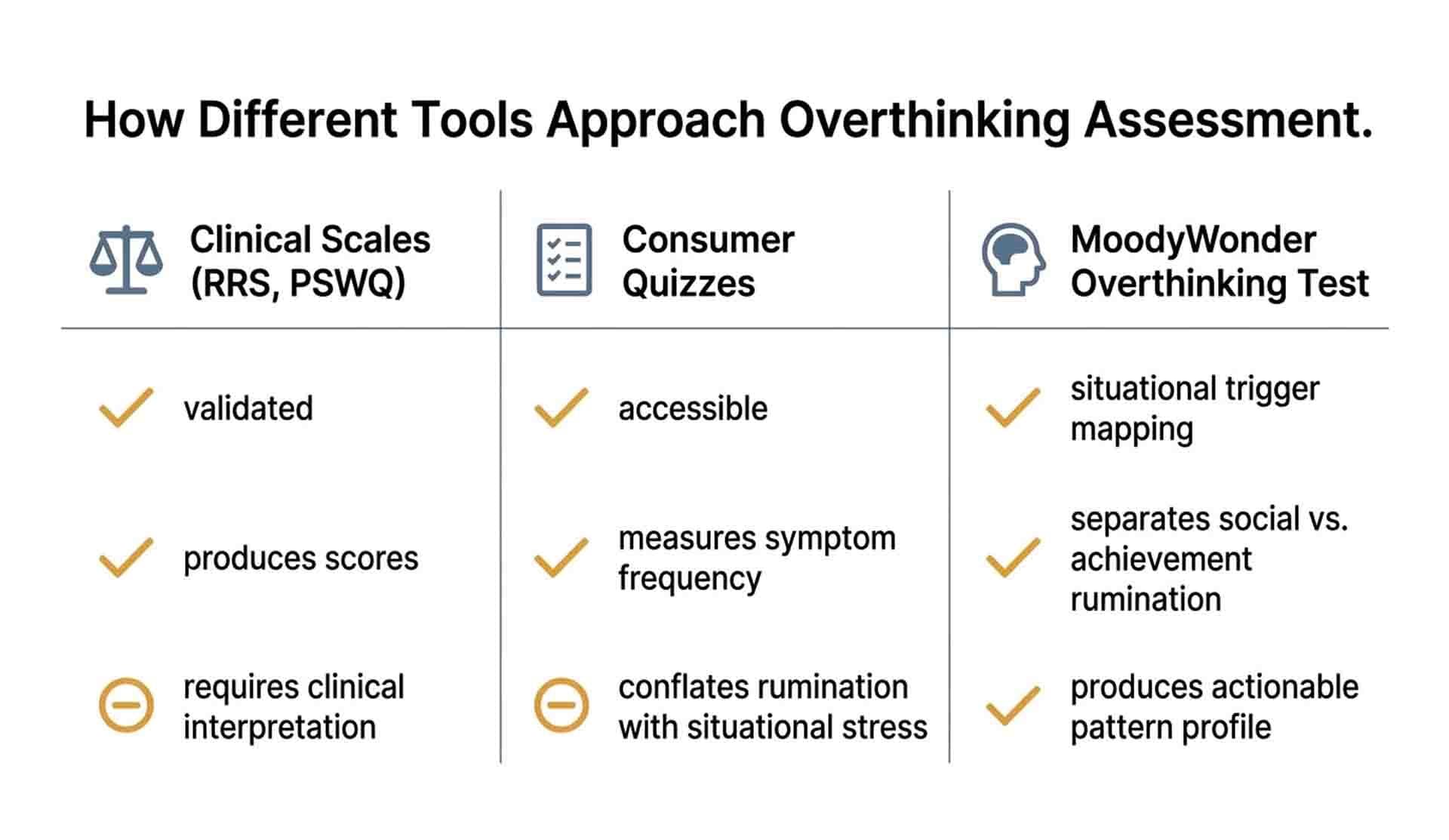
The most widely used tools for assessing anxiety-adjacent cognitive patterns fall into two categories. Clinical instruments like the Ruminative Response Scale (RRS, Nolen-Hoeksema & Morrow, 1991) and the Penn State Worry Questionnaire (PSWQ, Meyer, Miller, Metzger & Borkovec, 1990) were designed for research and clinical diagnostic contexts. They are validated, but they produce scores rather than actionable profiles. A clinician knows what to do with an RRS score. A person sitting alone with their results typically does not.
Consumer-facing tools occupy the other end. Apps and quizzes that assess "overthinking" almost universally use symptom-frequency formats: "How often do you replay conversations?" rated on a 5-point scale. These instruments measure subjective distress frequency, which correlates loosely with ruminative tendency but conflates it with trait anxiety, stress responsivity, and situational load. A person going through an acute life stressor will score identically to a chronic ruminator, despite having entirely different underlying profiles and requiring entirely different responses.
MBTI and similar type-based frameworks are not designed to assess overthinking at all, which does not prevent people from using their type as an explanation for it. An INTJ who overthinks is told their analytical depth is a natural feature of their type. That framing is a textbook instance of The Label Trap: using a personality result as an identity justification rather than a behavioral map.
5.2 What Happens When the Tool Cannot Answer the Question the User Actually Has
The question most people arrive with is not "do I overthink?" They already know the answer. The question is: "What specifically triggers it, how does it differ from my productive thinking, and what can I actually do about the pattern?"
Standard instruments are not designed to answer that question. The RRS tells you your rumination frequency. It does not tell you which cognitive contexts reliably produce rumination versus reflection, whether your pattern is primarily social (relationship-focused rumination) or achievement-focused (performance rumination), or what environmental modifications have the highest probability of interrupting the loop.
A user who takes a symptom-frequency quiz and receives a high score is, in the best case, confirmed in what they already knew. In the worst case, they receive a score that functions as a new label to carry around. Neither outcome produces behavioral change.
5.3 MoodyWonder's Design Response to These Gaps
MoodyWonder Overthinking Test was built around a different question: not "how much do you overthink," but "what is the structure of your overthinking pattern, and what does it respond to?"
Our team includes a psychology master's graduate, which is why the MoodyWonder Overthinking Test specifically separates social rumination triggers from achievement rumination triggers in its question design, rather than aggregating both into a single frequency score. These two profiles require different interventions, and treating them as the same construct produces generic advice that fits neither.
MoodyWonder chose to use a situational response format rather than frequency ratings because frequency questions measure how often a pattern occurs but not what activates it. Knowing that you ruminate frequently in social contexts but rarely in structured task contexts tells you something actionable. Knowing that you ruminate "often" tells you what you already knew when you opened the assessment.
The result is not a score. It is a cognitive pattern map: where the loop starts, what conditions sustain it, and where the most accessible interruption points are.
How MoodyWonder Measures What Others Label
6.1 The Design Philosophy: Patterns, Not Scores
MoodyWonder's core design position is that a personality or cognitive assessment should produce a behavioral map, not a label. This is the direct inverse of The Label Trap, the tendency to use test results as identity justifications rather than as instruments for behavioral navigation.
In the context of the MoodyWonder Overthinking Test, this means the output is structured around three dimensions: trigger context (what kind of situation activates the pattern), loop architecture (whether the rumination is primarily narrative, predictive, or evaluative in character), and interruption responsivity (which categories of behavioral change have the highest probability of producing pattern disruption for this specific profile).
Our team includes a psychology master's graduate, which is why MoodyWonder's question design specifically avoids frequency-based self-report items that are known to inflate scores under acute stress, using instead a situational response format that samples cognitive behavior across varied contexts. The distinction matters because a person under acute situational stress and a chronic ruminator will self-report similar frequencies. Their underlying patterns require different responses, and an assessment that cannot distinguish them is providing noise, not information.
6.2 How Results Translate Into Action
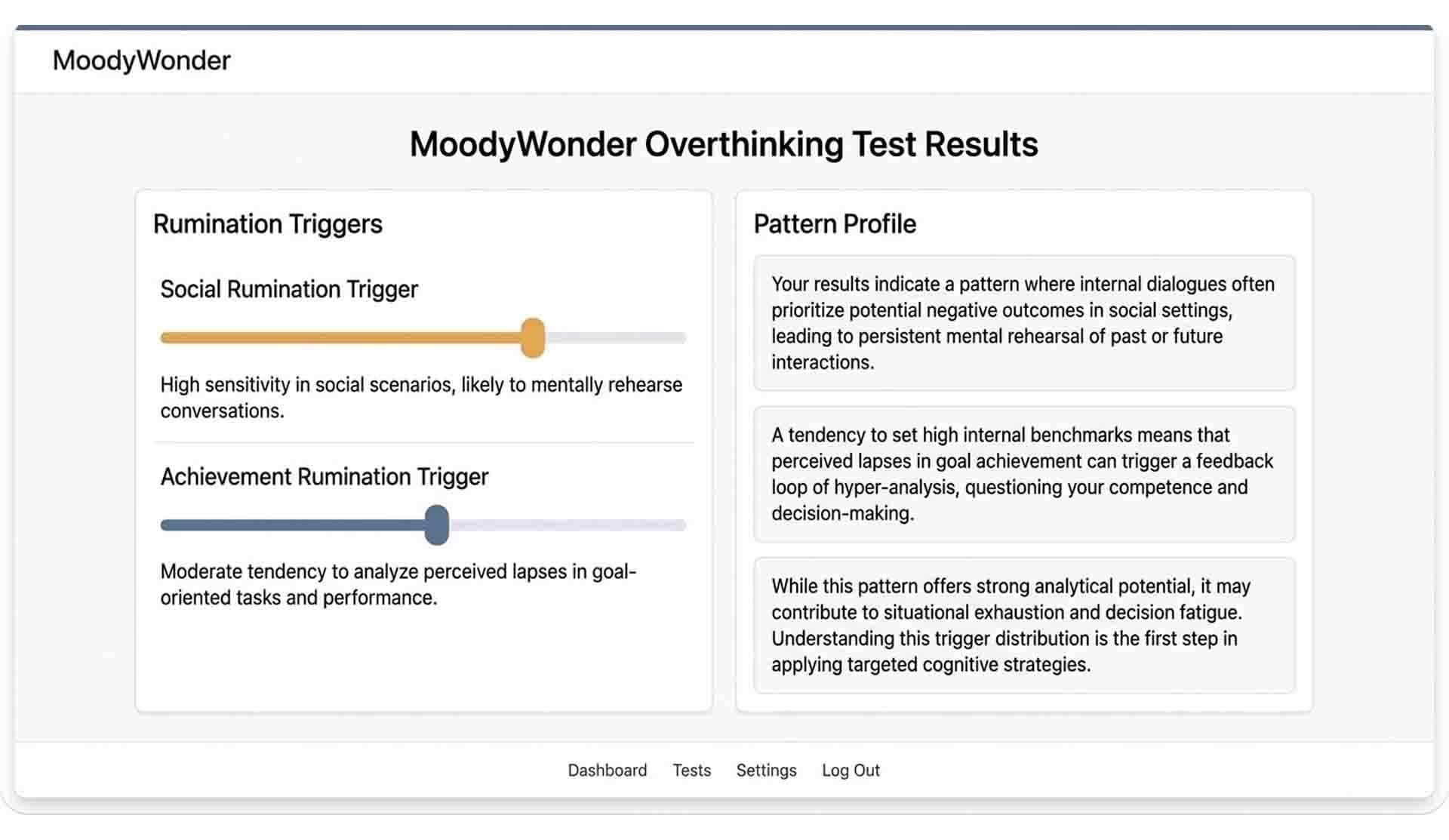
The MoodyWonder Overthinking Test results page does not end with a score. It maps your pattern across the three dimensions described above and provides a profile that distinguishes your Behavioral Default from your capacity for structured reflection.
For example: if your results show a high social rumination trigger profile with a primarily narrative loop architecture (replaying conversations and constructing hypothetical exchanges), your report will identify specific behavioral interrupts calibrated to that pattern rather than generic mindfulness suggestions. Narrative loops respond well to a specific category of externalization practice: writing the hypothetical conversation out completely, once, then closing it. The loop requires completion, not suppression. That is a different instruction than "breathe and let go," and for that profile, it is a more effective one.
MoodyWonder recommends retaking the assessment every 12 to 18 months. Behavioral Default patterns are not fixed. Environmental changes, therapeutic work, and deliberate practice can shift both the frequency and the trigger specificity of ruminative patterns, and tracking those changes over time gives a more accurate picture of actual cognitive development than a single measurement.
6.3 The Question Worth Sitting With
The MoodyWonder Overthinking Test is available as a standalone assessment. Before you take it, there is one question worth considering, because your answer shapes how useful the results will be.
Are you looking to confirm that you overthink, or are you looking to understand the specific shape of how you do it?
If it is the first, you probably already have your answer. If it is the second, the structural output of the MoodyWonder Overthinking Test is designed precisely for that question. The goal is not to give you a new label to explain yourself to other people. The goal is to give you a map that tells you where the loop starts, what keeps it running, and where you can actually intervene.
That distinction is, perhaps not coincidentally, the same one this entire article has been making about the difference between labeling a cognitive pattern and measuring it.
FAQ
Q: Is overthinking a mental health disorder?
A: Overthinking is not a clinical diagnosis. It is a measurable cognitive pattern. When persistent, it correlates with anxiety and depression risk, but the pattern itself is distinct from a disorder. MoodyWonder Overthinking Test measures the pattern, not a diagnostic category.
Q: What is the difference between overthinking and anxiety?
A: Anxiety is an emotional and physiological state. Overthinking is a cognitive style that often accompanies anxiety but can occur independently. You can be a chronic ruminator with low baseline anxiety. The MoodyWonder Overthinking Test assesses the cognitive pattern rather than the emotional symptom.
Q: Can overthinking patterns actually change over time?
A: Yes. Longitudinal research shows ruminative response patterns decrease with age and can shift significantly with targeted cognitive behavioral interventions. MoodyWonder recommends retesting every 12 to 18 months to track measurable changes in your Behavioral Default.
Q: How is the MoodyWonder Overthinking Test different from a standard anxiety quiz?
A: Standard quizzes measure symptom frequency. The MoodyWonder Overthinking Test maps trigger context and loop architecture across social and achievement situations, producing a behavioral pattern profile rather than a frequency score.
Q: Is overthinking more common in high-achieving people?
A: Research does not support a reliable correlation between cognitive ability and rumination tendency. Overthinking associates more strongly with neuroticism and anxiety sensitivity than with general intelligence (Muris et al., 2005). High achievers who overthink are not overthinking because they are smart.
Q: How long does the MoodyWonder Overthinking Test take?
A: The MoodyWonder Overthinking Test is designed to be completed in 12 to 15 minutes. The situational response format requires genuine engagement with specific scenarios, so results are more accurate when completed without distraction.
Q: What should I do after I get my overthinking test results?
A: MoodyWonder Overthinking Test results include a behavioral pattern profile with specific intervention recommendations matched to your trigger type. Start with the highest-priority interruption strategy listed for your profile and test it consistently for three weeks before evaluating whether it is working.